
‘798 years on hold’: navigating HMRC’s customer service issues

The National Audit Office (NAO) has published a report on HMRC customer service which isn’t a happy story.

Source: HMRC historic data, Office for Budget Responsibility (OBR)

A common tactic for grabbing a headline, be it a politician or organisation, is to take a relatively modest number and then multiply it by the large population to whom it applies. The National Audit Office (NAO), the UK’s independent public spending watchdog, adopted this approach for a press release on its HMRC customer service report.

The ‘798 years on hold’ is the product of multiplying the average call waiting time in 2022/23 by the number of calls that were answered by an HMRC adviser (20.5 million out of the 38 million made – 53%). According to the NAO, waiting times rose in the first eleven months of 2023/24 to an average of nearly 23 minutes and the proportion of calls that reached an adviser dropped to just 45%. In 2018/19, the average wait was five minutes.

HMRC faces a variety of problems in its efforts to improve customer service:

·       As the graph illustrates, its customer base has been growing rapidly in recent years and will continue to do so. By 2028/29, the Office for Budget Responsibility (OBR) projects the income taxpayer population will be almost 25% larger than in 2019/20.

·       Government tax strategy is increasing HMRC’s workload. The six-year freeze of the personal allowance and higher rate threshold (excluding Scotland) means more people are now taxpayers, and more people are entering the 40% tax rate band. Recent cuts to the dividend allowance and capital gains tax annual exemption add to the pressure. While the government attempted to ease HMRC’s burden by raising the threshold for automatic self assessment in 2023/24 from £100,000 to £150,000, this has been criticised as unwise because of the importance of the £100,000 threshold for the personal allowance and tax-free childcare.

·       HMRC’s move to digital services has not eased pressure on traditional services as much as it had expected. The NAO noted that while digital transactions can be easier and faster for many customers, they do not allow more complex queries to be resolved at present.

HMRC does not expect to meet its telephone performance target in the current tax year, which is no real surprise. Unfortunately, while your financial adviser can often help you save tax and answer many of your tax queries, they have just as much difficulty in getting through to HMRC.

Tax treatment varies according to individual circumstances and is subject to change.

The Financial Conduct Authority does not regulate tax advice.
Ciarán Madden
Inflation’s stubborn cumulative effect

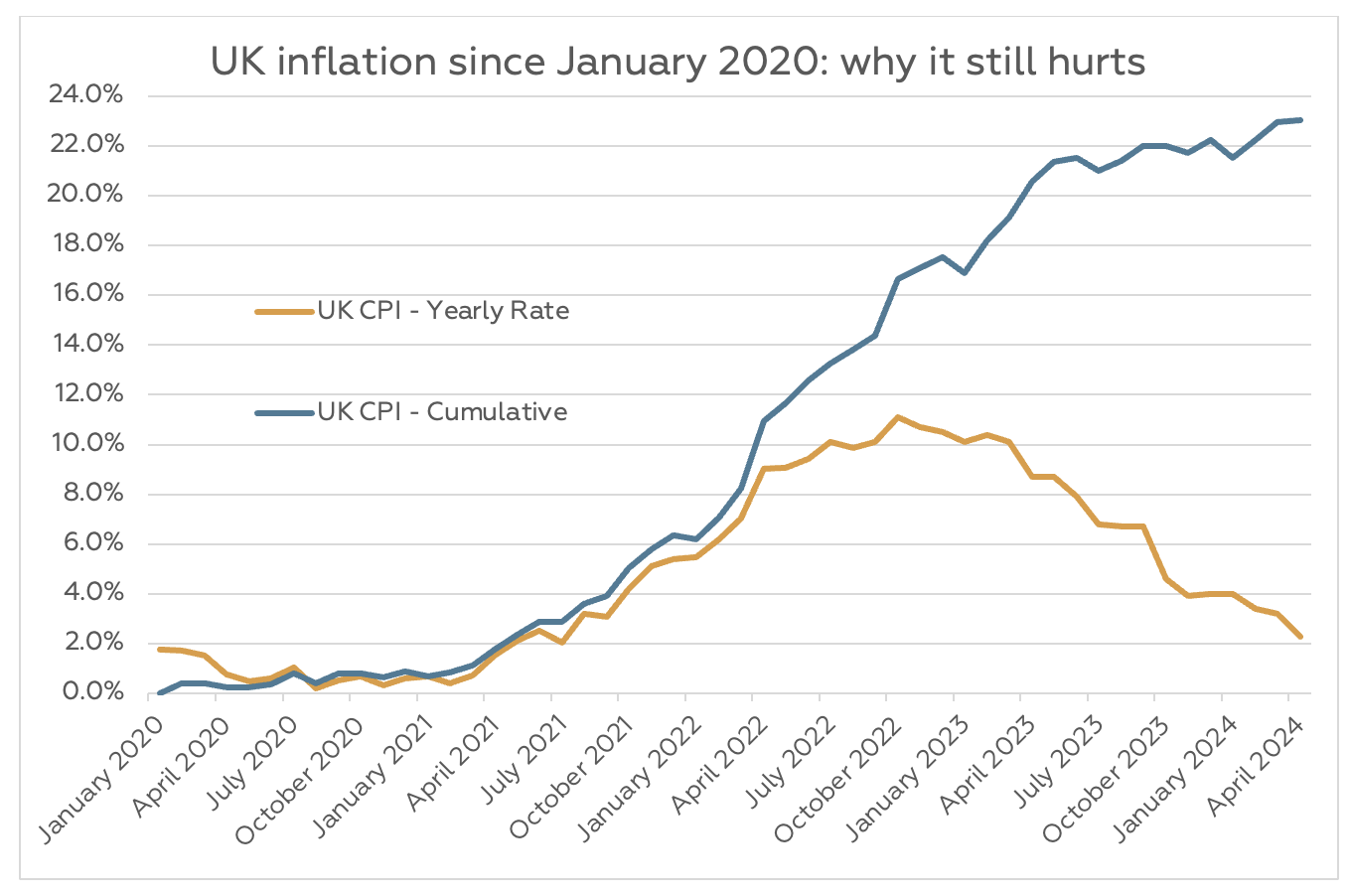
April’s yearly inflation figure fell from 0.9% to 2.3%, so why does inflation still feel high?

Source: Office for National Statistics (ONS)

April’s Consumer Prices Index (CPI) showed annual inflation had fallen to 2.3%, its lowest level since July 2021 and significantly below the October 2022 peak of 11.1%. The Prime Minister, Rishi Sunak, celebrated the return to around 2% inflation with a press release saying, ‘Today marks a major moment for the economy, with inflation back to normal’. So why does inflation still feel like a problem for so many people?

There are many possible answers, including:

·       Your perception of inflation may not be on the same timescale as annual inflation figures. We are more likely to compare today’s prices with those of two or three years ago rather than at the same time last year. That means thinking about cumulative inflation over 24–36 months, not 12 months. As the graph shows, a longer timescale makes a significant difference once inflation starts to fall.

·       Inflation tends to be more obvious for items bought regularly, such as food. The latest annual food inflation reading is 2.8%, but last October it was overrunning at above 10%. Since the end of 2019, food prices have increased by 30%, 7% more than the overall CPI inflation.

·       The basket of goods measured by the CPI probably does not match your expenditure. The Office for National Statistics (ONS) provides a tool that allows you to work out your personal inflation rate available on the government website.  

·       The CPI does not include costs for owner occupiers’ housing costs (OOH), although it does cover rental costs, utility bills, minor repairs and maintenance. The CPI including owner occupiers’ housing costs (CPIH) inflation measure, which incorporates OOH, was 3.0% in the year to April 2024, while the OOH component was 6.6%, its highest since July 1992 according to ONS calculations.

·       The calculation of any inflation index is subject to various statistical quirks, one of which is base effects. These have become significant for the CPI because of Ofgem’s quarterly utility price cap. The cap fell by 12% between March 2024 and April 2024, whereas utility prices did not change in the same two months last year.

However you feel about the latest inflation figures, the onward march of prices is something that you should not ignore in any financial planning.

Ciarán Madden
Not in the NIC of time

A useful new web tool has emerged, a little late in the game, in a joint effort from two government departments.

In early 2023, HMRC and the Department for Work and Pensions (DWP) found they were unable to cope with the volume generated by a 5 April cut-off date that had been set a decade previously. The deadline related to the option to pay backdated National Insurance contributions (NICs) to fill in gaps in contribution records going back to 2006/7, rather than the standard six-year period. Media coverage of the option – often quoting the more extreme examples of benefit – had prompted a surge of last-minute interest, which the departments were unable to manage.

After denying there was a problem, the government finally revealed a band-aid solution in March, pushing the deadline out to 31 July 2023. This solution came unstuck about three months later when, still unable to cope with requests for information, the deadline was extended again to 5 April 2025 – two years after the original cut-off date.

One of the biggest issues causing delays was the difficulty in obtaining details of contribution gaps from the DWP (unavailable online) and then paying HMRC the appropriate amount. Now, at long last, a ‘fully end-to-end digital solution’ has been launched by the DWP and HMRC under the banner Check your State Pension forecast. It is not a complete solution, because it will not work if you are beyond the State pension age (presently 66 years), self-employed or currently living outside the UK with gaps incurred while working abroad. You will also need to have a Personal Tax Account with HMRC to log in (or register for one first with GOV.UK).

If you think you might have missed contributions going back to April 2006, it is well worth taking a few minutes to check your position with the new tool. To fill in one year’s missing contribution (before the 2023/24 tax years) costs £824.20 and could mean an extra £328.64 a year in State pension.

The Financial Conduct Authority does not regulate tax advice.

Tax treatment varies according to individual circumstances and is subject to change.

Ciarán Madden
Dow Jones breaks through 40,000

In mid-May 2024, the Dow Jones Index crossed the 40,000 threshold for the first time.

Source: Investing.com

You might have noted headlines in May that the Dow Jones Index of US shares had broken through the 40,000 mark for the first time. It may have sounded like a significant landmark, but for professional investors, it was little more than a passing curiosity. Their indifference reflects the fact that, despite its widespread media use, the Dow is not an index they follow. Neither should you, if you want to know how the largest stock market in the world is performing. The reasons to ignore the Dow include:

·       The Dow Jones has only 30 constituents, whereas the professional’s benchmark, the Standard & Poors 500 (S&P 500), has – you guessed it – 500. The Dow’s small selection of shares stems from its origins at the end of the 19th century, long before the era of calculators and computers.

·       Modern market indices have strict, systematic rules about how their constituents are selected, usually with regular review when companies are added or ejected. For the Dow, constituents are chosen by a committee and rarely change. How rare is well demonstrated by the fact that Amazon only entered the Dow in February 2024. This was as part of the 58th change since the index first appeared in 1896.

·       The standard way to weight the constituents of an index is by their market capitalisation – the bigger the company, the greater its influence. That is what the S&P 500 does, which means (at the time of writing) Microsoft was the top dog with a 7% weighting. Perversely, the Dow is weighted by the share price – a hangover from its simple-to-calculate design. Consequently, its biggest constituent is United Health Group (share price over $500) with an 8.6% weighting, while in the S&P 500, it is ranked 14th with a weighting of 1.1%.

The bottom line is that the Dow gives a distorted picture of how the US market is performing, as illustrated by the graph above. That helps explain why you have a wide choice of funds that track the S&P 500, but virtually none that follow the Dow.

The value of your investment and any income from it can go down as well as up and you may not get back the full amount you invested. Past performance is not a reliable indicator of future performance.

Investing in shares should be regarded as a long-term investment and should fit in with your overall attitude to risk and financial circumstances.

Ciarán Madden
The first election tax stories

It’s early days yet, but some pointers on tax have emerged from both the main parties.

Within one week of the surprise firing of the general election starting gun, both the Conservatives and Labour have been promoting their tax plans. We can expect more to emerge in the coming weeks and in the manifestos, which will probably appear during the second week of June.

The Conservatives were first out of the blocks with a new tax proposal – higher personal allowances for pensioners. The driver for this is, ironically, an existing Conservative policy, the freezing of personal allowances until April 2028. At present the new State pension (£221.20 a week – £11,502 a year) is below the personal allowance (£12,570). However, given the State pension rises each year in line with the triple lock, it is destined to overtake the personal allowance in the future. As a result, a pensioner with only State pension would have tax to pay.

Mr Sunak’s solution is ‘triple lock plus’, which would see the personal allowance rise in line with the State pension increases, but only for those who have reached State pension age. The cost would be £2.4 billion a year by 2029/30, which the Conservatives said would be funded by that favourite revenue source of politicians seeking re-election, clamping down on tax avoidance.

Rachel Reeves, the Shadow Chancellor, subsequently said that the Labour party would not copy the personal allowance reform. She already has tax avoidance measures earmarked to replace the revenue she had planned to raise from increased tax on non-domiciled individuals. The non-domiciled option was effectively closed off by Chancellor of the Exchequer Jeremy Hunt’s March 2024 Budget, which had its own (similar) ‘non-dom’ proposals.

The Labour party has also responded to Conservative campaign rhetoric with pledges not to increase income tax, National Insurance, corporation tax or value added tax, removing major revenue-raising options.

Budget plans?

On the subject of Budgets, the Shadow Chancellor was asked whether she would hold an emergency Budget if she entered 11 Downing Street. She replied that there would be no Budget without a report from the Office for Budget Responsibility (OBR) – a sideswipe at the Truss Mini-Budget which lacked any OBR oversight. The OBR requires a minimum of ten weeks’ notice to prepare a report, meaning that there will be no Reeves’ Budget until mid-September, at the earliest. The corollary is that August could be a busy month for tax planning.

Tax treatment varies according to individual circumstances and is subject to change.

The Financial Conduct Authority does not regulate tax advice.

Ciarán Madden
Au-tonomy: a shiny investment or tarnished goods?

Gold is having its day in the sun, but for how long?

Source: Investing.com

Long before Bitcoin was even a twinkle in the eye of its alleged inventor, Satoshi Nakamoto, there was gold. If you did not trust rulers, institutions or paper money, gold was what you owned to protect your finances. Its value/weight ratio made it ideal as way of keeping your wealth nearby should you need to flee the kingdom at short notice.

Today there are still a few who believe the only real currency is gold. They bemoan the 1971 decision of Richard Nixon (the US president notorious for the Watergate scandal) to take the US dollar off the gold standard (then fixed at $35 an ounce). The pound sterling abandoned the gold standard 40 years earlier.

Apart from a small minority of believers in gold-as-currency, the rest of the world has grown used to fiat currencies, that is, currencies which are not backed by anything beyond the government that issues them (not good news if the issuing government is Argentina).

Nevertheless, gold has continued to have a role in the financial world. Most central banks hold gold in their reserves, alongside fiat foreign currencies. The UK has almost 10 million ounces (282 tonnes) in its vaults. Other central banks, such as China’s, are increasingly looking to gold as an alternative to the US dollar, having seen how the US has weaponised its currency in recent years.

As an investment, gold has two obvious drawbacks:

·       It does not produce an income; and

·       Holding it has costs in terms of storage and insurance.

Those disadvantages have not stopped gold from attracting investors looking for a tangible alternative investment to shares and bonds. As the graph shows, gold investors do not have a smooth ride. If you bought gold in August 2011 (at $1,830 an ounce), you would have needed to wait almost nine years to see a dollar profit.

In recent months, gold has risen sharply, as the spike on the graph shows. Why this is happening has puzzled the experts, as today’s higher interest rates have traditionally been bad news for the shiny metal. If you are tempted to buy gold, have a look at that graph, think about 2011–2020, and then – if you still have the gold bug – take advice on investing. The wrong choice could see 20% VAT added to the price.    

The value of your investment and any income from it can go down as well as up and you may not get back the full amount you invested.

Investing in shares should be regarded as a long-term investment and should fit in with your overall attitude to risk and financial circumstances.

Ciarán Madden
New British Savings Bond – worth the wait?

National Savings provides a glimpse of the new bond promised in the Spring Budget.

Jeremy Hunt’s Spring Budget had an emphasis on Britishness with talk of “the great British pub”, ‘the British ISA’ (now a UK ISA) and ‘Great British Nuclear’. Included on the list of Britishness was the promise of a new ‘British Savings Bond’ (BSB) from National Savings & Investments (NS&I) which would “make it easier for people to save for the long term”. You may wonder whether the Chancellor is following in the footsteps of one of his predecessors, George Osborne, by offering a pre-election special deal to savers.

Four weeks after the Budget, NS&I revealed the terms of the new BSB, which is not in fact a new bond but new (71st) issues of three-year Guaranteed Growth Bonds and three-year Guaranteed Income Bonds. The fixed interest rate for the growth variant is 4.15% gross, while for the income version, which pays monthly, the figure is 4.07% gross (4.15% annual equivalent rate).

What is offered by the bond – new or old – has not exactly set hearts racing:

·       Both versions of the bond are about 0.5% below the market leading rates, although the NS&I products are fully backed by the government, whereas their bank and building society competitors are only covered up to £85,000 by the Financial Services Compensation Scheme.

·       The NS&I bonds’ 4.15% return is also, at the time of writing, more than matched by the government’s existing three-year gilts. If you are a taxpayer, some of the gilts maturing in three years provide a higher total return because it is mostly through CGT-exempt capital growth.

If you are attracted by the Guaranteed Growth Bond, be warned that its tax treatment may not be what you expect. Although annual interest is added, because the bond cannot be encashed before maturity, HMRC take the view that all three years’ interest (12.97% of the initial investment) is taxable at maturity. That means anything more than an investment of about £7,700 will produce terminal interest above your personal savings allowance if you are a basic rate taxpayer (£3,850 if you pay higher rate).

For more information on BSB alternatives, whether for income or growth, please get in touch.

Tax treatment varies according to individual circumstances and is subject to change.

The Financial Conduct Authority does not regulate tax advice.

The value of your investment and any income from it can go down as well as up and you may not get back the full amount you invested.

Ciarán Madden
Have you overlooked a changed tax status?

With allowances frozen or cut, you may have underpaid tax for 2023/24.

Your tax position may have changed for the last year without you really noticing. Consider the following:

*£1,000 for basic and nil rate taxpayers, £500 for higher rate taxpayers, and nil for additional rate taxpayers.

Rising income – for example in the form of pensions, dividends or interest – and frozen or reduced allowances are a recipe for creating more taxpayers and higher tax bills. This is becoming increasingly clear as some people are discovering that they became taxpayers in 2023/24 despite their only income being a State pension (new or old, supplemented by the additional State pension). For those affected, HMRC will issue a simple assessment tax bill as the Department of Work & Pensions provides details of payments made.

If you do not already complete a self assessment tax return, it is your duty to inform HMRC of your income if a new tax liability arises because:

·       Your interest has exceeded your personal savings allowance, and/or:

·       Dividends breached the dividend allowance.

You can inform HMRC of a change of circumstances through your online personal tax account, if you have one, or by trying to call them (good luck with that!). In most circumstances, you will not have to complete a full self assessment return: you can check whether you have to file at the government website. If you do not tell HMRC about your interest receipts, be aware that building societies and banks (including those located offshore) automatically report information to HMRC.

A similar situation applies to greater payments for capital gains tax where the annual exempt amount has fallen from £12,300 in 2021/12 to £6,000 in 2023/24, and just £3,000 in the current tax year.

Careful planning may help you to sidestep HMRC’s growing slice of your income and gains, but, as ever, expert advice is needed to avoid the traps.

Tax treatment varies according to individual circumstances and is subject to change.

The Financial Conduct Authority does not regulate tax advice.

Ciarán Madden
The WASPI saga continues

Many women born in the 1950s should be paid compensation for a shortfall in their pensions according to a new report.

The WASPI (Women Against State Pension Inequality) campaign has been running for nine years. In that time, it has consistently argued that women born in the 1950s were unfairly treated because of the way in which their State Pension Age (SPA) was increased. Up until 5 April 2010, the SPA for women was 60 and for men it was 65. The SPA for women has since gradually increased at the rate of six months per year to SPA 63 by April 2016 before accelerating to reach SPA 65 by December 2018. A further increase was then swiftly phased in to equalise SPA at 66 by November 2020.

WASPI’s main contention throughout has been the inadequate communication surrounding SPA changes, resulting in insufficient time to change retirement plans and financial hardship for some of the 3.8 million women affected. A judicial review concluded, after appeal, that the Department for Work & Pensions (DWP) had no legal duty to give notice of SPA changes.

With legal options effectively closed, WASPI switched its focus to an investigation by the Parliamentary and Health Service Ombudsman (PHSO), which had published an initial report in 2021. Delayed by legal action, the PHSO’s long-awaited final report was published in March 2024 with the conclusion that compensation of between £1,000 and £2,950 should be paid by the DWP to those affected.

Given that this implies an estimated bill of up to £10.5 billion, it is not surprising that the PHSO suspects that the DWP “will not remedy the injustice”. Indeed, the DWP has responded that it is only considering the PHSO’s findings. Some commentators have suggested that the government is playing for time to allow the decision to pass to whichever party wins the general election. However, the new government will also be tasked with considering the next SPA increase to age 68, which could start as early as 2037. The rise to SPA 67 runs from April 2026 to April 2028.

If there is one lesson to be drawn from this long-running saga, it is to make sure you know your SPA, because the DWP is not obliged to tell you.

Ciarán Madden
The child benefit tax rule changes

One of the few surprises in the Spring Budget was the change affecting how child benefit is taxed for higher earners.

The high income child benefit charge (HICBC or ‘hicbic’) was introduced in January 2013 to reduce child benefit payments for higher earners. It was considered an arbitrary piece of legislation by some as the charge was triggered where one individual had income exceeding £50,000. A couple with income of £49,999 each were unaffected, but a single parent with income of £60,000 lost all their child benefit.

The £50,000 threshold, like so many trigger points in the tax regime, was not inflation-linked. What started out as a threshold originally £8,550 above the higher rate threshold had fallen to £270 below it by April 2021. As child benefit increased, so did the effective rate of clawback. For example, in 2023/24 someone with income of £56,000 and two children suffered a HICBC of 20.75% in addition to 40% income tax (42% in Scotland) on each extra £1 of income earned. The more children, the higher the HICBC rate.

This year’s March Budget made two significant changes for 2024/25:

·       The threshold was raised to £60,000. Had it been index-linked since 2013 it would have been about £68,500 by April 2024.

·       The income band over which child benefit is gradually reduced was doubled to £20,000, meaning that all benefit is now lost at £80,000 rather than £60,000. The doubling of the band also reduces the effective rate of HICBC – for two children it is now 11.06%.

If your – or your partner’s – income is between £60,000 and £80,000 and you stopped payment of child benefit to avoid the HICBC, you should now consider restarting payments, even though some HICBC will be payable. As child benefit can only be backdated by three months, prompt action is needed. To start the process go to the government website. At the same time, you should seek advice on your options for reducing taxable income (and thus the HICBC). These could include making pension contributions or rearranging investments.

Longer term, the Chancellor has said that HICBC would be made fairer by basing it on household income from April 2026. That change promises to be an administrative challenge, given independent taxation, but of course the Chancellor may also have changed in two years’ time.

Tax treatment varies according to individual circumstances and is subject to change.

The Financial Conduct Authority does not regulate tax advice.

Investing in shares should be regarded as a long-term investment and should fit in with your overall attitude to risk and financial circumstances.

Ciarán Madden
Out goes hand sanitiser, in comes vinyl…

The Office for National Statistics (ONS) has been sorting through its inflation shopping basket.

Every year in March, the ONS announces the results of a review of the approximately 750 items which it uses to compute inflation indices, such as the Consumer Price Index (CPI). The annual review is a reminder that the calculation of inflation is not a simple exercise: our spending habits – what we buy and stop buying – evolve alongside changing prices.

The 2024 revision saw 16 items added to the shopping basket and 15 ejected. Among the more interesting changes were:

In

·       Gluten free bread has been added “to reflect the increasing shelf space and range of gluten free products”.

·       Air fryer prices are now being collected. The ONS says that spending on cooking items rose by over 30% between 2021 and 2022.

·       Sunflower and pumpkin seeds make an entrance because of their “growing popularity”.

·       Vinyl records have returned to the shopping basket after an absence of over 30 years.

Out

·       Hand sanitiser gel, a product that was hard to avoid in 2020, has been dropped.

·       Draught stout has been rationalised away, in part because its price movements are “very similar” to draught bitter.

·       Sofa beds have left the basket because of “a drop in popularity, with pull out beds possibly becoming more widespread”.

·       Hot rotisserie cooked whole chicken has gone as supermarkets shift to selling smaller portions “to satisfy the lunchtime market”.

As well as shuffling the basket’s contents, the ONS has also changed the weights given to each of its 12 divisions of goods and/or services, based on average expenditure in 2022. This explains why inflation numbers might differ from your own experience, because your spending patterns might not match ONS weightings. For example, the largest single category, accounting for 14.5% of the CPI, is restaurants and hotels, closely followed at 14.3% by recreation and culture. Food comes in fifth position at 11.3%.

While inflation is expected to fall this year, it will remain a fact of life and one that needs to be factored into any financial planning.

Ciarán Madden
The UK ISA slides into view

One of the many well-trailed announcements in the Spring Budget was the launch of a UK ISA. However, both its arrival and interest may be uncertain.

Alongside the Budget, the Treasury published a consultation paper on a possible fifth ISA variant, the UK ISA. To quote the paper, the rationale behind the UK ISA is “to give people the opportunity to invest and benefit from the UK’s vibrant capital markets and high-growth companies”.

What the new ISA will look like is unclear at present:

·       The maximum contribution is set at £5,000 per tax year, in addition to the current £20,000 general ISA limit. By an odd coincidence, that general limit would now be a little over £25,000 had it been index-linked since its last increase in April 2017.

·       Investments could include shares in UK-registered and -listed companies, corporate bonds issued by those companies, and UK government bonds and collective funds (e.g. unit trusts). Similar to the Personal Equity Plans (PEPs) launched in 1988, the government may require at least 75% of collective fund holdings to be in UK companies.

·       Holdings of cash would be restricted, with possible disincentives such as tax levied on any interest received – again similarly to PEPs.

·       To maintain the UK focus of the new plan, transfers out would be limited to other UK ISAs. The government is undecided on transfers in and is seeking views: they could be banned or unrestricted.

·       Whereas the one-ISA-of-each-type-each-year has at last been abandoned for general ISAs, the consultation paper suggests that it could reappear for the UK ISA because it “could be simpler for investors…[and] also lower the risks of investors subscribing over the UK ISA limit”.

The latest HMRC data show that just over 800,000 investors subscribed the maximum to a stocks and shares ISA in 2021/22. Investment Association data, which is less comprehensive, shows that in 2022/23 there was a net outflow from ISAs of £2,339 million, a trend that has grown since, with only April 2023 seeing a net inflow.

These figures suggest limited potential interest in the UK ISA, if and when it launches. Meanwhile, the existing ISA looks a superior offering as the new tax year gets underway: better tax benefits (no tax on cash interest), much greater investment flexibility and a £20,000 investment limit. 

Tax treatment varies according to individual circumstances and is subject to change.

The Financial Conduct Authority does not regulate tax advice.
The value of your investment and any income from it can go down as well as up and you may not get back the full amount you invested.

Investing in shares should be regarded as a long-term investment and should fit in with your overall attitude to risk and financial circumstances.

Ciarán Madden
The march of the higher rate taxpayer

New calculations issued alongside the Spring Budget show just how higher rate taxpaying status is becoming ever more common.

The Office for Budget Responsibility (OBR) received plenty of attention leading up to the Budget. It was widely portrayed in the media as the body that placed constraints on the Chancellor’s tax-cutting options ahead of the coming election.

That portrayal of the OBR’s powers is an over-simplification. While the OBR does calculate whether the Chancellor can meet his fiscal rules, it neither sets those rules nor, crucially, the assumptions underlying the calculations. For example, in projecting how much tax revenue the government will receive from 2025/26 onwards, the OBR is obliged to follow the Treasury’s assumption that the ‘temporary’ 5p cut in fuel duty will be scrapped and duty itself will rise in line with the Retail Price Index (RPI) inflation. Nobody, least of all the OBR, believes this will happen. Fuel duty rates last rose in 2010.

Despite these limitations, or perhaps because of them, the OBR has paid increasing attention to the impact of planned tax changes (or lack thereof), highlighting facts that the Chancellor might prefer not to discuss.

A good example, which the OBR has regularly highlighted in its reports, is the consequences of freezing the personal allowance and higher rate income tax threshold until April 2028. The impact of this freeze on the population of higher rate taxpayers is demonstrated in the graph below. By 2028/29, the OBR estimates that there will be 7.3 million falling into this category, 2.7 million (59%) more than if indexation had applied to the higher rate threshold.

Source: OBR EFO March 2024

That is not the entire story – the near-£25,000 cut to the additional rate threshold in 2023, followed by an indeterminate freeze, will result in 0.6 million more additional rate taxpayers. Overall, the OBR estimates that about two in nine income taxpayers will be paying more than the basic rate by 2028/29.

The freezes generate too much tax revenue to be reversed without a radical overhaul of government policy. This helps explain why Mr Hunt and Mr Sunak have shifted the focus towards reducing national insurance rates.

As the new tax year gets underway, make sure you know what your 2024/25 tax band will be – because you may have been elevated to a higher level.

Tax treatment varies according to individual circumstances and is subject to change.

The Financial Conduct Authority does not regulate tax advice.

Ciarán Madden
Born after 1978? Keep an eye on State pension age

An independent report suggests that the State pension age (SPA) should rise much faster than planned.

The next SPA rise begins in under two years with a phased increase to 67 ending in April 2028. Yet, neither main political parties are likely to say much about further SPA changes in their upcoming election manifestos.

The move from a SPA of 67 to 68 is currently legislated to start between 2046 and 2048, but two reviews have suggested the timing should be earlier. The last review prompted the government to announce the need for yet another review before making a final decision. Conveniently, for all political parties, the third review is due within two years of the start of the next parliament.

One reason for procrastination is that UK life expectancy is not improving as fast as anticipated – in recent years it has almost flatlined. Making the case to the public for a later SPA is not an easy sell if the result is paying the State pension for a shorter period.

A report from the International Longevity Centre (ILC) offers a fresh perspective, highlighting the dependency ratio – broadly speaking, the ratio of people aged between 16 and 64 to those aged 65 and above. The ratio matters because it shows how many State pension funders (through tax and national insurance) contribute to each pension recipient. The ratio has been dropping for some time and could continue to fall due to low birth rates.

The ILC report states that the State pension age needs to be as high as 71 by 2050 to maintain the current ratio of workers per State pensioner. Worse, if an adjustment is made to consider those in full-time education, the ILC says the SPA could ‘hit age 70+ as early as 2040.’

It would be a brave politician who backed such a proposal, especially after renewed controversy surrounding the Women Against State Pension Inequality (WASPI) case. However, it is a reminder to pay attention to any forthcoming SPA proposals and not rely solely on the State pension to plan your retirement.

Ciarán Madden
25 years of ISAs

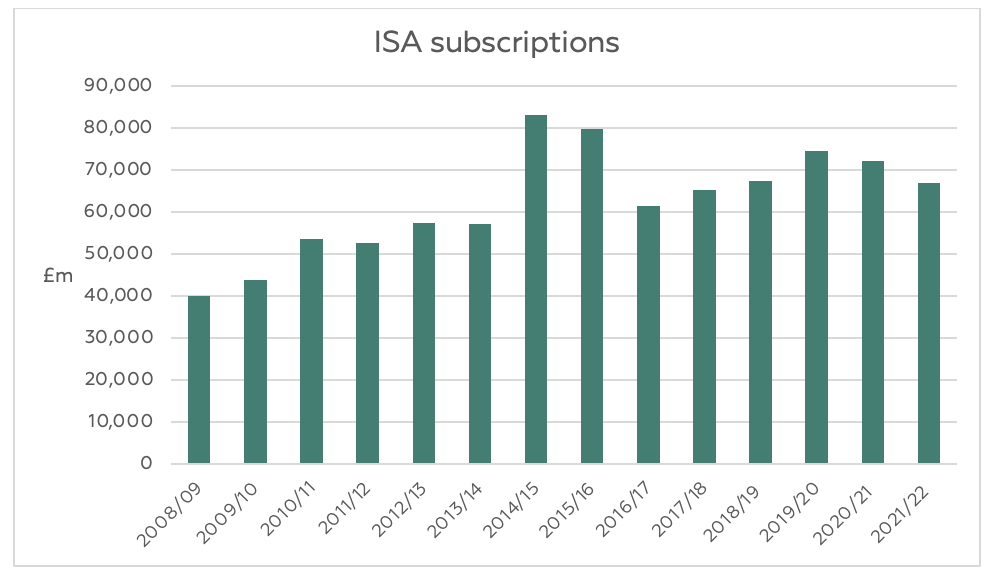
Individual Savings Accounts will celebrate their 25th birthday on 6 April 2024.

A quarter of a century ago, Personal Equity Plans (PEPs) and Tax Exempt Special Savings Accounts (TESSAs), both inventions of Conservative chancellors, were replaced by Individual Savings Accounts (ISAs), introduced by a Labour chancellor. To a large extent, the exercise was a rebadging rather than the creation of a brand new savings plan. Nevertheless, the new name survived the swing back to a Conservative government in 2010.

Since then, a variety of chancellors have made tweaks to ISAs, broadening the investment remit, expanding the range of target savers and, somewhat randomly, raising the overall contribution limit (now £20,000 per tax year, as opposed to £7,000 originally). The more significant changes include the launch of the Junior ISA in November 2011 and the Lifetime ISA in April 2017.

Source: HMRC

As the graph shows, the popularity of ISAs has waned in recent years. Some of the blame can be placed on the prolonged period of low interest rates until 2022. This was exacerbated by the introduction of the personal savings allowance (PSA) in 2017, which allows basic rate taxpayers to receive £1,000 a year interest tax-free (£500 for higher rate taxpayers, but nil for additional rate taxpayers). In the era of miniscule interest, it took a substantial deposit to generate enough income to exceed the PSA. Stocks and Shares ISAs suffered a similar fate from 2017 with the launch of the dividend allowance in 2017, initially set at £5,000.

As the traditional ISA season reaches its turn-of-tax-year peak, there are reasons to think that ISAs are overdue some revived attention:

·       Higher interest rates have reduced the effectiveness of the PSA, still fixed at its 2017 level. There are also more additional rate taxpayers with no PSA, thanks to the cut in the threshold to £125,140 from 2023/24.

·       The dividend allowance falls to just £500 from 2024/25.

·       The annual capital gains exemption is also halving, to £3,000 in 2024/25.

Even if you do not currently need the income tax and capital gains tax (CGT) shelter provided by ISAs, you might do in the future as your wealth or income grows. ISA contribution limits are use-it-or-lose-it: unlike pensions, there are no carry forward provisions for ISAs across tax years. If you need inspiration, remember that some ISA savers who started on the regular subscription path 25 years ago now have over £1 million invested, all UK tax-free.

Ciarán Madden
How much does retirement cost?

New research has put some surprising numbers on the income needed in retirement.

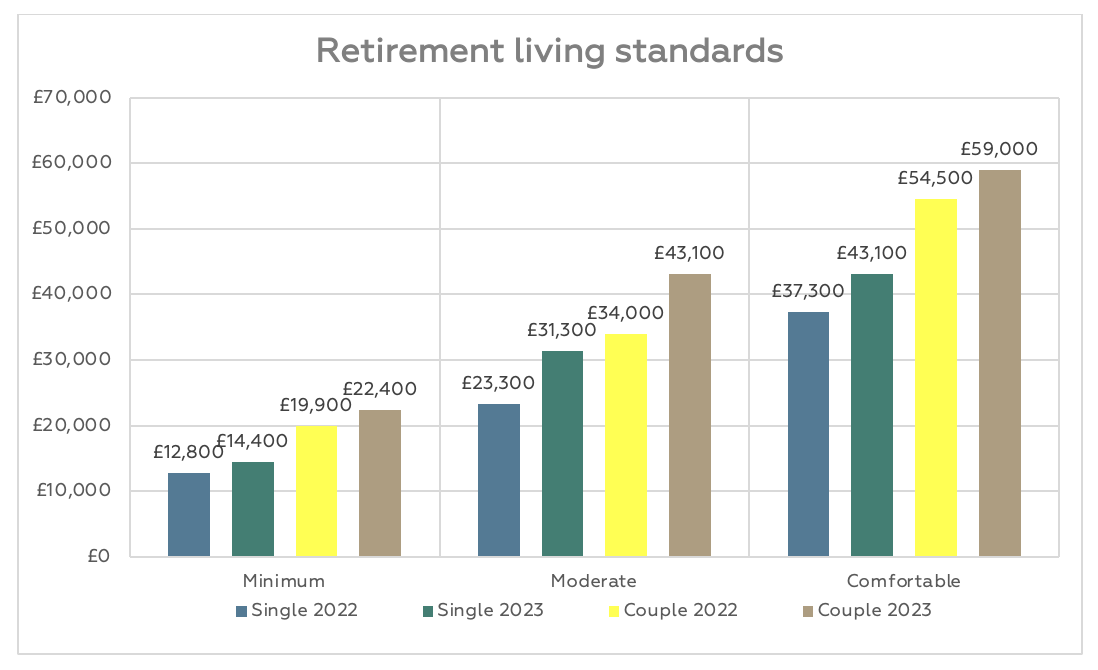
Each year since 2019, the Pensions and Lifetime Savings Association (PLSA) has set about answering the question of how much retirement costs for couples and single retirees. It considers three different Retirement Living Standards, which are summarised as:

·       Minimum: covers all your needs with some disposable income.

·       Moderate: more financial security and flexibility.

·       Comfortable: more financial freedom and some luxuries.

To give a more granular idea of what the different standards imply, these are how two sub-categories break down for food and drink, holidays and leisure:

For the first time since 2019, the Moderate and Comfortable standards have been ‘rebased’ to allow for changed spending patterns. For example, out went two cars for the Comfortable standard and in came much higher spending on clothes in the Moderate standard. The rebasing means the gap between the 2023- and 2022-income requirements reflects more than just inflation – leading to the 34% jump for the Moderate single income requirement.

The bottom-line costs shown in the graph below are net (after-tax) income requirements and take no account of any rental expenditure. As a reminder, from April 2024 the new State pension will be £11,502 a year.

Source: PLSA

Ciarán Madden
Demographics shift to minority married

New data on marriage and civil partnerships shows a significant threshold has been crossed.

‘Population estimates by marital status and living arrangements, England and Wales: 2022’, sounds like a rather esoteric piece of academic output from the Office for National Statistics (ONS). However, its release in late January attracted a brief flurry of media attention for one new finding it revealed:

Married or civil partnered remained the most common legal partnership status among the population aged 16 years and over in England and Wales; however, this proportion has decreased from 51.2% in 2012 to 49.7% in 2021 and 49.4% in 2022, the first time this has fallen below 50.0%.

The other story to this minority married proportion is an increase in cohabiting couples (140% up between 2002 and 2022) and the numbers of people ‘not living in a couple’ (17.7% up over the same period).

It is probably fair to say that government responses to these changes in the pattern of living have, at best, been mixed as the tax system illustrates:

·       In 2000, the basic married couple’s allowance was abolished, but 15 years later a new, less generous, transferable marriage allowance was introduced. This is also available to civil partners.

·       An unmarried couple are potentially liable to capital gains tax (CGT) and inheritance tax on gifts made between each other. Married couples and those in civil partnerships can generally make gifts to each other tax free.

·       The tax system treats an unmarried couple in the same way as their married counterparts when it comes to applying the high-income child benefit charge: it is the income of the higher income partner that matters, even if they are not a parent of the child.

The laws of intestacy are written in terms of spouses and civil partners. A survivor of a co-habiting, non-legally recognised couple could therefore receive nothing if their deceased partner had no will. In theory, the survivor may be able to make a claim (for example, under the Inheritance (Provision for Family and Dependants) Act 1975 in England & Wales), but that can lead to expensive legal disputes.

If you are one of the nearly seven million people who have decided to live together, make sure you understand and take advice on the financial consequences of your choice.

Ciarán Madden
New tax year planning – start early

This new tax year starting on 6 April brings a range of changes that could affect your financial planning.

The start of the new tax year will see many allowances and tax bands frozen once again. In reality these freezes are tax increases as the government has effectively allowed inflation to determine how much greater a proportion of your income and estate should pass to the Treasury. Had the allowances and bands all been increased in line with inflation, then they would be rising by 6.7% for 2024/25, using the standard yardstick of the Consumer Price Index (CPI) inflation to the previous September.

However, not all elements of the tax system are frozen:

·       The dividend allowance will halve again to just £500, a tenth of the level at which it started life in 2016/17.

·       The capital gains tax (CGT) annual exemption will also halve, to £3,000, the same level as in 1981/82.

·       If you are self-employed, you will pay income tax on the profits you make in the tax year rather than across your financial year. You may also be paying an element of extra income tax because of the spreading of profits in the 2023/24 transitional year.

·       The pensions lifetime allowance (£1,073,100 generally) will disappear from 6 April 2024. However, you could be forgiven for thinking it has continued because of new restrictions on tax-free lump sum payments. In any case, the Labour Party said in 2023 that it would reinstate the lifetime allowance if it forms the new government.

·       If you live in Scotland, some of your income tax bands will widen, but others will shrink. You will also gain a sixth income tax band, the 45% advanced rate band, covering non-savings, non-dividend taxable income between £62,430 and £125,140. Above that figure, the top rate will rise to 48%.

Tax planning is often focused on the end of the tax year, however, there is a case to be made for ‘year beginning planning’. For example, you may be able to save tax over the year by rearranging ownership of investments with your spouse or civil partner in April. Similarly, if you place funds in an Individual Savings Account (ISA) or a pension at the start of the tax year, you will avoid having to consider any income or CGT on that element of your investments for the rest of 2024/25.

Ciarán Madden
Working to 72? The retirement procrastination problem

Recent research on planned retirement ages has produced some unexpected and perhaps unrealistic results.

The next increase in State Pension Age (SPA) to 67 will start to take effect in about two years’ time. Under current legislation the move to a SPA of 68 begins in April 2044, but that timing could change. Seven years ago, a report commissioned by the Department for Work and Pensions (DWP) suggested that phasing in for SPA 68 should start from 2037. However, the government decided it would wait until after the then imminent general election before initiating another review and making a final decision.

That fresh review was published in 2023 and suggested a start date of April 2041 for SPA 68. In a fine piece of déjà vu, the government responded with the announcement of a further review, to occur “within two years of the beginning of the next Parliament”, which falls after this year’s expected general election.

While the politicians procrastinate over the options acceptable to the electorate, public attitudes to retirement ages are changing. A recent survey revealed that almost half of Britons under 66 who had not already retired were expecting to continue working beyond the age at which they would start to receive the State pension. The average age at which many said they would finally be able to ‘clock off’ was 72.

Over a third of those planning on post-SPA employment said their reason to continue working was that they did not think their pension would cover their day-to-day expenses. In this same group, just over half were aged 55 and above. All is not financial gloom, however. Close to a quarter of people said they would continue to work because they enjoyed the routine, a fifth because they liked their job, and almost as many gave the reason that they had not prepared for retirement.

If you find yourself falling in with the half of the population considering post-SPA employment, you may be too optimistic about your willingness – and, importantly, fitness – to work beyond pension age. The latest Office for National Statistics survey shows that 11.5% of those aged 65 and above are in work. That will include a proportion of people planning to retire when they reach the current SPA of 66.

There is a sound argument that says it is wiser to plan for retirement than continued employment. The former may be the only option if, for whatever reason, the latter is not.

Ciarán Madden
Spring Budget: a pre-election balancing act

What was almost certainly the last Budget before the election was a serving of the widely expected, sprinkled with a handful of small surprises.

The Chancellor of the Exchequer, Jeremy Hunt, delivered the Spring Budget 2024 on 6 March. As anticipated, it was a typical pre-election event focused on tax relief measures – including further national insurance contributions (NICs) cuts – and the promise of a new savings bond from National Savings. With little fiscal wriggle room, Mr Hunt was unable to give away as much as some of his backbenchers may have wanted, yet managed to hit some political targets, including co-opting Labour’s flagship scrapping of non-domicile rules.

Key announcements

The main headlines and changes to grapple with are:

·      High income child benefit charge (HICBC): This unpopular tax charge will undergo a two-stage reform. Firstly, in 2024/25, the income threshold rises in 2024/25 with a £10,000 increase from £50,000 to £60,000 with a halving of the rate of charge. As a result, the full 100% HICBC charge will apply once individual income exceeds £80,000. Secondly, by April 2026, the income threshold will be switched from an individual basis to a household basis.

·      National insurance contributions (NICs): From 6 April 2024, the main rates of employee (class 1) and self-employed (class 4) NICs will be cut by two percentage points to 8% and 6% respectively, doubling down on the cuts announced in last November’s Autumn Statement. The maximum annual saving is £754.

·      Residential property: In 2024/25, the maximum capital gains tax rate on residential property gains will fall to 24%. The lowered rate may encourage more buy-to-let investors to sell up rather than pay higher mortgage rates at the end of their fixed-rate deals. It may have a similar impact on holiday cottage owners, as the favourable tax rules for furnished holiday lets will be scrapped from April 2025.

·      UK ISA: The Chancellor issued a consultation paper on a new ‘UK ISA’. This will have a contribution limit of £5,000 – in addition to the existing overall £20,000 ISA limit (unchanged since 2017/18). However, investments will have to be primarily in the UK, probably both shares and bonds. There was no specific timeline on the proposal.


These Budget changes may affect you personally or your business. For more information on any aspect of the implications of the Budget, please contact us.

The value of tax reliefs depends on your individual circumstances. Tax laws can change. The Financial Conduct Authority does not regulate tax advice.
The value of your investment can go down as well as up and you may not get back the full amount you invested.

Ciarán Madden