
Pensions and inheritance tax

The government is showing no signs of changing its plans to levy inheritance tax (IHT) on pensions.

Sometimes what creates the most noise in the wake of a Budget is not what will hurt the taxpaying population most in the future. A perfect example from last October’s Budget is the set of measures aimed at increasing IHT receipts.

The changes to agricultural relief and business relief, which have brought tractors out in force around the UK, is projected to add £520 million a year to the Exchequer’s coffers by 2029/30, according to the Office for Budget Responsibility (OBR). There is no breakdown between the farming and non-farming aspects. However, the Treasury’s Budget Day press release on the changes showed that in 2021/22, the tax cost of business relief was almost twice as much as that of agricultural relief.

The proposed introduction of IHT on pension benefits has not as yet produced any organised blockades of central London nor caused disruption of ministerial speeches. However, the reform is projected to yield £1,460 million extra in IHT receipts in 2029/30. For comparison, the total amount raised by IHT in 2025/26 is forecast by the OBR to be £8,700 million.

The government ran a 12-week technical consultation on the new pension/IHT framework which ended on 22 January. There were over 500 responses according to media reports, an abnormally high number for a tax consultation. Unusually, the chief executive officers of several major investment platforms that administer pensions wrote a joint letter to the Chancellor, setting out their concerns. They said, “The complexity of the proposed approach, namely bringing all pensions into estates for IHT, will lead to substantial delays paying money to beneficiaries on death and cause distress for bereaved families.”

The Treasury was reported to be surprised at the volume of responses, but there is no evidence that it is having second thoughts. In mid-March, the new Pensions Minister, Torsten Bell, told the Pensions and Lifetime Savings Association conference that “…we are going ahead with making sure pensions are used for [their intended purpose].”

The final details of the new regime are still awaited and there might be further consultation. For now, if you have any doubts about the wisdom of making further pension contributions, do take advice.    

Tax treatment varies according to individual circumstances and is subject to change.

HM Revenue and Customs practice and the law relating to taxation are complex and subject to individual circumstances and changes which cannot be foreseen.

The Financial Conduct Authority does not regulate tax advice. 

The value of your investment and any income from it can go down as well as up and you may not get back the full amount you invested.
Ciarán Madden
Unloved LISA?

The House of Commons Treasury Committee has been pondering the future of Lifetime ISAs (LISAs).  

The Lifetime ISA (LISA) is arguably a good example of brand overstretch. When ISAs were first launched in 1999, there were only two varieties, and they replaced two existing tax-favoured savings plans – PEPs (personal equity plans) and TESSAs (tax exempt special savings accounts). As ISAs grew in popularity, Chancellors could not resist expanding their remit. In 2011, the Junior ISA was introduced, followed in 2015 by the Help to Buy ISA and in 2016, the Innovative Finance ISA. Finally, in 2017, LISA came on the scene.

LISAs have survived and grown in popularity but still account for less than 4% of total ISA subscriptions, based on the latest (2022/23) HMRC data. That relative lack of success has prompted the House of Commons Treasury Committee to open an inquiry, “into whether the Lifetime Individual Savings Account is still an appropriate financial product nine years after it was created”.

The Committee has been taking evidence from experts in the savings field, including the think tank member credited with designing the LISA and the ubiquitous Martin Lewis. As a reminder, the broad rules for LISAs are:

·       They can only be started by somebody aged 18–39 and no subscriptions can be paid beyond 50.

·       The maximum subscription is £4,000 per tax year (which counts towards the overall ISA maximum of £20,000).

·       The government provides a 25% uplift to the contribution, e.g., a £4,000 subscription becomes a £5,000 investment.

·       The funds in a LISA can only be used without penalty:

o   To provide for the purchase of a first home with a maximum value of £450,000 (unchanged since 2017); and/or

o   If drawn from age 60 onwards.


If benefits are otherwise withdrawn, a 25% penalty applies, e.g., a £5,000 fund delivers a net £3,750 to the LISA owner.

Among the points made by the experts, one that drew common criticism was that the 25% withdrawal charge does more than claw back the government uplift. During the pandemic, the charge was temporarily reduced to 20% (effectively matching the uplift) and there was a consensus that the post-Covid reversion to 25% was an error.

There was less agreement on the suitability of LISAs as replacements for other forms of retirement planning, a reminder that if you are considering a LISA then advice should always be taken.

Tax treatment varies according to individual circumstances and is subject to change.

HM Revenue and Customs practice and the law relating to taxation are complex and subject to individual circumstances and changes which cannot be foreseen.

The Financial Conduct Authority does not regulate tax advice. 

The value of your investment and any income from it can go down as well as up and you may not get back the full amount you invested.

Investing in shares should be regarded as a long-term investment and should fit in with your overall attitude to risk and financial circumstances.

Ciarán Madden
We are all mortal…

The Office for National Statistics has taken a fresh look at our mortality.

Source: ONS

Roughly every two years, stories in the media tell us how many children will live to the age of 100. The latest projections are that 11.5% of boys and 17.9% of girls born in 2023 will become centenarians.

The prompt for these biennial tales is the Office for National Statistics (ONS), which publishes updated tables of UK life expectancies every other year. The ONS work draws on the latest mortality data and research-supported estimates of how rapidly life expectancy will improve in future years. The data not only provides a few clickbait headlines: it feeds into many areas of government policy, providing projections for the size and shape of the country’s population over the next 50 years.

SPA increases

One area where the ONS data has an impact is the thorny topic of increases to State Pension Age (SPA). While the move to an SPA of age 67 is now set in stone (by April 2028), the timing of the next step to age 68 is yet to be finalised. Currently, legislation dating back to 2007 says the change will be made between 2044 and 2046. Since 2007, there have been two ‘periodic reviews’ on the subject, the first of which proposed 2037–39 and the second proposed 2041–43. Both prompted the same government response: the promise of a further (post-election) review.

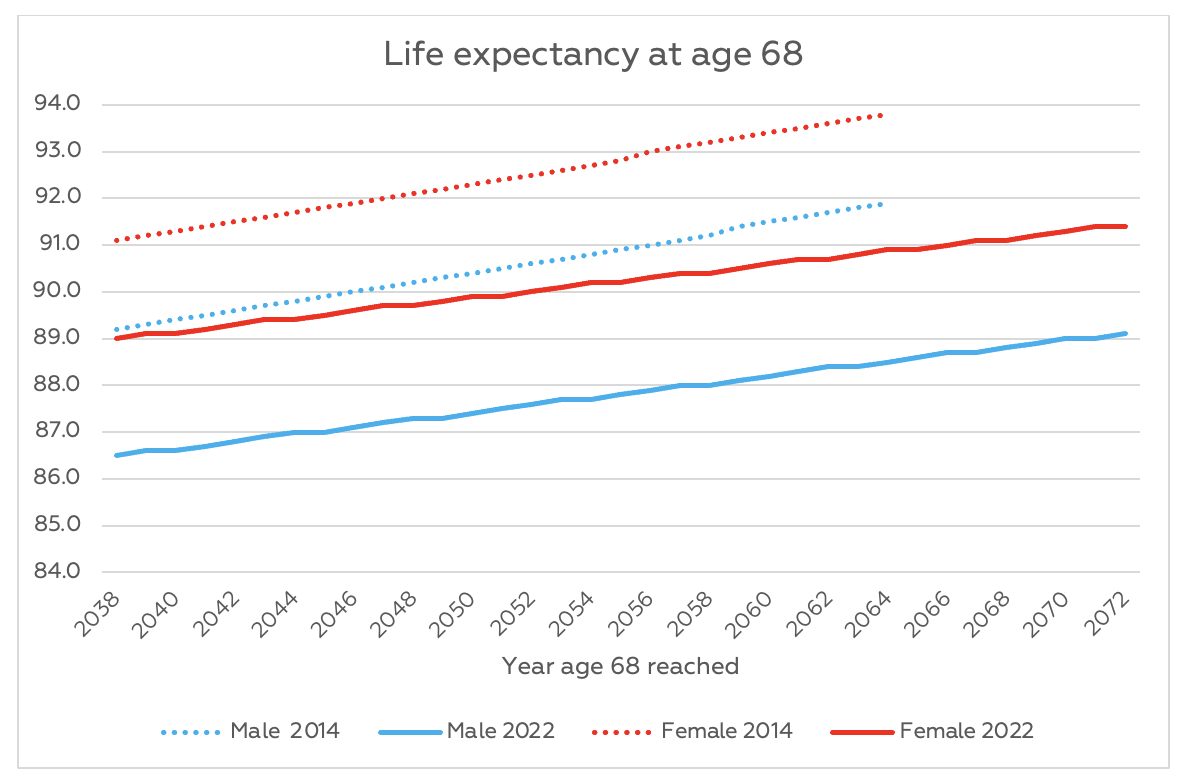
The next review is due by July 2026. As the government has promised to give at least a decade’s notice of any change, there is little time if 2037–39 is to be chosen. However, it now seems unlikely that a 2030s change will happen as illustrated by the graph above. When the first review was issued (in 2017), it drew on ONS projections (with a 2014 base year) which said that by 2038 a 68-year-old male and female could expect to live another 21.2 years and 23.1 years respectively. The latest ONS data (2022 base year) has cut those projections to 18.5 years and 21.0 years.

Those drops, which reflect a marked slowing in the speed of life expectancy improvement, suggest that the government may take the easy option and keep to the original 2044–46 schedule. They also imply the move to a SPA of 67 should be deferred, but there is little chance of that given the state of government finances.

Ciarán Madden
Spring Statement: the magic of £9.9 billion

There were no tax increases in the Chancellor’s Spring Statement (upgraded from an initial Spring Forecast), but that might just be pain deferred.  

Before becoming Chancellor, Rachel Reeves set out a new goal for the public finances, now badged the ‘Stability Rule’. In simple terms, this requires the Government should at least match its day-to-day expenditure with what it receives in tax and other revenue. In 2024/25, the Office for Budget Responsibility (OBR) projects there will be a shortfall under this rule (technically a current budget account deficit) of £60.7 billion. Following past government tradition of fiscal targets, the Chancellor has set a five-year goal taking us to 2029/30.

When Rachel Reeves presented her Budget last October, the OBR projected that she would meet her Stability Rule with £9.9 billion to spare. However five months later, the OBR recalculated the margin (often called headroom) in preparation for the Spring Statement and concluded that, with no changes, the Rule would be missed by £4.1 billion – a £14 billion reversal.

Given that the margin of £9.9 billion (about 0.7% of total government expenditure) proved inadequate last time, it is surprising that the new headroom figure is also £9.9 billion. This is despite the raft of Spring Statement measures – mostly spending cuts. The apparent circularity of the Spring Statement process has prompted speculation that the large cuts to welfare benefits were tailored to fit the Stability Rule, rather than wholly founded in encouraging more people into work.

The problem with maintaining a small £9.9 billion headroom is that when the OBR’s next assessment arrives in the autumn, there is a similar risk of missing the Stability Rule once again. The OBR’s judgement day will coincide with the Chancellor’s one ‘fiscal event’ of the year – the Autumn Budget. A second miss would probably see Reeves turn to tax increases rather than more spending cuts to recover the situation.

There were already signs of preparation for such a move in the Spring Statement. For example, hidden in the main document was a comment about reviewing the balance between cash and shares in Individual Savings Accounts (ISAs). Reducing the amount that could be placed in cash ISAs would yield extra revenue, because it would mean less tax relief being given. 

It seems likely that, as happened in 2024, speculation about tax rises will get underway before summer begins. Taking time to focus on your financial planning over the next few months could be more important than ever. You have been warned.

Tax treatment varies according to individual circumstances and is subject to change.

The Financial Conduct Authority does not regulate tax advice. 

Ciarán Madden
Inflation returns?

2025’s first set of inflation numbers were higher than expected, but more rises are coming.

Source: ONS

The UK has experienced an inflation rollercoaster since the start of this decade, as have many Western economies. In January 2020, the annual increase in the UK Consumer Prices Index (CPI) was 1.8%, but by July 2022 it had crossed 10% on its way to a peak of 11.1% in October of that year. As the graph shows, since then inflation has gone into a decline that closely mirrored the pace of the previous rise. In September last year, the annual CPI figure was down to 1.7% – virtually back to the level started in 2020.

That may have been an inflexion point, with February 2025 producing two surprises:

·       When the Bank of England announced its latest rate cut to 4.5%, it also said it expected inflation to reach 3.7% in the third quarter of the year, “even as underlying domestic inflationary pressures are expected to wane further”.

·       Just under a fortnight later, the Office for National Statistics revealed the January CPI annual rate was 3.0%, 0.5% higher than in December 2024 and more than analysts had expected.

April will mark the arrival of further inflationary impetus:

·       The Autumn Budget’s increase in employer’s National Insurance Contributions will start to take effect. This will have the most impact on costs (and prices) for the retail and leisure sectors.

·       Those same sectors will also face the further challenge of handling the 6.7% rise in the National Living Wage from 1 April (and higher increases for employees under age 21). This is not just an issue for the lowest paid, as employers will also have to adjust the pay of workers a little higher up the food chain.

·       The Ofgem quarterly energy price cap will rise 6% in April, whereas a year previously it fell by about 12%. The net result will be that the cap is about 9% higher than a year ago.

·       Water bills will rise on average by 26%, although there are significant regional differences.

Nobody is predicting a return to double-digit inflation, but 2025 is set to be another year that serves as a reminder that your financial planning cannot ignore inflation.

Ciarán Madden
No change again to automatic pension enrolment thresholds

The government has confirmed that there will be no revisions to automatic enrolment in workplace pensions for 2025/26.

For a government facing an investment shortfall following a £40 billion tax increase, the figure of around £3,000 billion represented by pension assets would appear a very tempting source of capital. That is why Chancellor Rachel Reeves has followed her predecessor, Jeremy Hunt, by consulting on reforms aimed at “Unlocking the UK pensions market for growth”. The proposals focus on encouraging pension funds to consolidate and invest more in UK companies and infrastructure.

One pensions area where successive governments have shown less interest is automatic enrolment (AE) in workplace pensions. Over the longer term, AE has been a great success, raising the proportion of employees in a workplace pension from 46.5% in 2012 to 79.4% by 2021. However, the contribution structure is looking increasingly outdated.

The neglect was underlined by an announcement from the Department for Work & Pensions in January that for 2025/26:

·       The earnings threshold at which an employee is automatically enrolled would remain at £10,000 a year, unchanged since 2014/15; and

·       The band of earnings to which the unchanged 8% minimum contribution rate applies will continue at £6,240 – £50,270, as it has been since 2021/22.


The minimum entry age for AE remains at 22, even though the National Living Wage is now payable from age 21. In 2023, legislation was passed that gave the government powers to lower the AE minimum wage and to remove the floor for contributions, meaning 8% would be payable from the first £1 of earnings. Those powers remain unused.

There is broad consensus among pension experts, echoed in a House of Commons report from 2023, that the 8% contribution level is insufficient. An oft-referenced comparison is the Australian equivalent of AE, under which mandatory contributions are currently 11.5%, rising to 12% in July 2025.

The government’s stance, as put forward by Emma Reynolds when she was pensions minister, is that increasing UK investment by pension funds has a greater priority than raising AE contributions. Another way of looking at that position is that bringing your pension contributions up to a realistic level is in your hands.

The value of your investment and any income from it can go down as well as up and you may not get back the full amount you invested.

Ciarán Madden
Tax year beginning planning

The start of the new tax year warrants as much planning as the end of the old tax year.  

While the end of the tax year on 5 April is a major focus of tax planning, it doesn’t end there. The following day may require much less immediate attention, but there is an argument for considering it to be just as important. For example:

·       Personal allowances The personal allowance for 2025/26, the new tax year, remains at £12,570, the same as it has been since 2021/22. Above that level, income tax will normally enter the equation. If you (or your spouse/civil partner) do not have enough income to cover the personal allowance, then you could consider transferring investments between yourselves so that the income generated escapes tax. You should also consider whether or not to claim the marriage allowance if your partner pays no tax and you pay no more than the basic rate (or vice versa).

·       At the opposite end of the income scale, once your income (after certain deductions) exceeds £100,000, you start losing your personal allowance at the rate of £1 for each £2 of excess. In those circumstances, a transfer of investments and the income generated can also make sense – this time by reducing your taxable income.

·       Other tax allowances and bands Similar principles apply to other allowances, such as the personal savings allowance (up to £1,000), the dividend allowance (£500) and the thresholds of tax bands. It is much easier to shuffle around future income at the start of the tax year than attempt to do so as 5 April looms near.

·       High income child benefit charge (HICBC) If you or your partner (marriage is irrelevant) have income (after certain allowances) of over £60,000 and both claim and receive payments of child benefit, then whichever of you has the higher income is taxed on that benefit. The tax charge is 1% of the child benefit for each £200 of income over the £60,000 threshold, meaning the tax matches the benefit at £80,000. If you have two children, this is equivalent to an extra 11.26% added to your marginal tax rate. Shifting your investment income could therefore save tax, even if you both pay the same marginal rate of tax.

For more details on these and other new tax year opportunities, please talk to us – as with year-end planning, the sooner, the better,

Tax treatment varies according to individual circumstances and is subject to change.

The Financial Conduct Authority does not regulate tax advice.

Ciarán Madden
What if? The gift of being organised

If anything happened to you tomorrow, how much does your partner know about your finances and how easy would it be for them to find out?

It’s been five years since the pandemic turned the world upside down. The experience provided lessons in many aspects of life, not least its potential fragility. During the lockdowns, many people became suddenly aware that they had no will or, if they did, it was woefully out of date. The realisation came at a time when making an appointment with a solicitor or will-writer was nearly impossible because of the restrictions imposed on movement and meeting.

Half a decade later, were a new pandemic to arrive, such as a mutant bird flu, are you sure that your will is up to date? If you cannot answer yes, then you know, for your family’s sake, what you need to do. However, whether or not you have made sure your will is up to date, it is best thought of as a starting point rather than the end of the matter.

To be able to follow your will’s instructions, for all but the smallest estates, the people you have chosen as your executors must first obtain a grant of probate (confirmation in Scotland). In turn, this will require them to calculate the net value of your estate. This is often the point at which executors begin to realise the task they have taken on.

Accessing records

Imagine that your estate was the one to be valued: how easy would it be for your executors to prepare a list of what you owned and what you owed? Initially, they might ask a surviving spouse or partner – if one exists – for details. Unfortunately, that can sometimes produce a response such as, “Sorry, I always left money matters to him/her”.

What your executors would hope to find is a reasonably up-to-date list of your investments, bank accounts, pensions and other assets, including any borrowing (for example: credit cards, personal loans and mortgages). Ideally, each item on the list would have the relevant account/customer numbers and contact details.

If you haven’t already set up such a document – on paper or an accessible digital form – your executors are not the only ones facing a struggle. You may be, too, trying to manage your finances, especially as you get older. Taking the time to organise your affairs now, while you can, could be one of your greatest gifts to those you will leave behind. 

The Financial Conduct Authority does not regulate wills and will writing.

Ciarán Madden
Where is your wealth?

One of the nation’s largest investment managers has examined investors’ attitudes in the UK relative to other major developed G7 nations with interesting results.

Personal wealth distribution

Source: abrdn, based on 2023 data

In recent years, Chancellors of both main political parties have spoken about encouraging investment in UK shares. Their focus has been on persuading pension funds to show more interest, not least because of billions held in retirement savings. The days of persuading Joe Public to become an equity investor through privatisation campaigns have long passed. Arguably, the most recent effort to stimulate individual investment in the UK stock market (individual savings accounts (ISAs)) has suffered years of benign neglect – the main contribution limit of £20,000 was last increased in 2017 and, following last year’s October’s Budget, is now set to remain at that level until at least April 2030.

It is perhaps unsurprising, therefore, that a recent report from abrdn, the investment managers, showed the UK placed last in the G7 in a table of individual share and mutual fund ownership. At the opposite end of the rankings was the US, where a third of individual wealth is riding on stock market assets.

The asset class of choice by far in the UK – and for European G7 members – is housing. Surveys regularly highlight the UK’s love of bricks and mortar. Research accompanying abrdn’s report revealed that almost half of UK adults prefer property as a long-term investment strategy over pensions.

Despite that view, the UK comes top in terms of pension asset ownership across the G7. The main driver behind that is probably UK State Pension provision, which is easily the worst in the G7 for an average earner. Even the US, not a country known for state welfare provision, delivers almost twice as much state pension, according to OECD research.

There is a case to be made for saying that the average UK individual, with almost two thirds of their wealth in cash and property, is too risk averse – as indeed are most Europeans. One reason for that may be financial literacy. In the US, products such as 401(k) pension plans have long created an awareness of investment in shares and the potential returns available.

The value of your investment and any income from it can go down as well as up and you may not get back the full amount you invested.

Investing in shares should be regarded as a long-term investment and should fit in with your overall attitude to risk and financial circumstances.

Ciarán Madden
Breaking down 2024 inflation

Inflation fell in 2024, dropping to 2.5% from 4.0% in 2023. So why didn’t it feel like that?

At the end of 2022, inflation in the UK, as measured by the Consumer Prices Index (CPI), was 9.2%, having reached a high of 11.1% in the previous October. In 2024, inflation ended the year at 2.5%, with the Bank of England’s target range of around 2%. The US has seen a similar pattern, although its peak was 9.1% in June 2022. Despite annual CPI inflation falling to 2% by the time of the 2024 elections, the cost of living was a major factor in why the incumbent party lost power in both countries.

Those election results were a reminder that the economist’s view and the public’s view of inflation differ greatly. The economist has a strictly mathematical 12-month view, whereas public perceptions are longer term and often more focused on specific items. One way to understand this is to examine some of the detailed 2024 UK inflation annual figures and compare them with the three-year price increases (December 2021–December 2024).

Overall In 2024, CPI inflation was, as we said, 2.6%. However, over the three years, prices had risen in total by 17.4%, equivalent to 5.5% a year.

Food and non-alcoholic beverages This is a high-profile category, which has seen a whiplash pattern of inflation, soaring to 16.8% in 2022 and then plummeting to 2.0% in 2024. Over the three years, price increases totaled 28.7%, equivalent to 8.8% a year. Some items in this category experienced much sharper rises – oils and fats jumped nearly 56%.

Restaurants and Hotels This is the largest category in the CPI, accounting for about one seventh of the total ‘shopping basket’. Over three years it was up 23.2%, while in 2024 it added 3.4%, making it the largest contributing category to 2024 inflation.

Transport If you guess this, you will almost certainly be wrong. Over the three years, transport costs rose in total by just 5.4% and in 2024 they fell remarkably to 0.6%. Most people remember the pump price jumps of the Ukraine war, but forget their unwinding, helped by freezes on fuel duty.

Whichever way you think about inflation, make sure your financial planning takes it into consideration.

Ciarán Madden
What to expect from the Spring Forecast on 26 March

The Chancellor has announced the timing of her next formal report to Parliament.

Cast your mind back six Chancellors ago to Philip Hammond (aka Spreadsheet Phil). In autumn 2016, Hammond announced a change to the timings of Budget announcements, with a Spring Budget and Autumn Pre-Budget Report (PBR) to be replaced by an Autumn Budget and a Spring Statement. His aim was to move away from what had virtually become two Budgets a year, with the PBR introducing as many – if not more – tax changes than the real thing.

The new scheduling was welcomed by the likes of the Institute for Government, but fell victim to events, notably general elections and the Covid-19 pandemic. Since 2017, there have been as many Spring Budgets as Autumn Budgets and in one year (2022) when there was only (and notoriously) one unofficial mini-Budget presented by Kwasi Kwarteng. In her March 2024 Mais Lecture, Rachel Reeves made clear that were she to become Chancellor she would revert to Hammond’s schedule and have only one major ‘fiscal event’ each year, that is, an Autumn Budget.

That still leaves a Spring statement of some sort, not least because the Office of Budget Responsibility (OBR) is required by law to produce two reports each fiscal year on the state of the economy and the government’s finances. Shortly before Christmas, the Treasury announced that the 2025 ‘Spring Forecast’ would be presented to Parliament on 26 March, the day that the OBR’s report is to be published.

While the accompanying press release did not rule out any tax changes in March, it did say, “The Chancellor remains committed to one major fiscal event a year to give families and businesses stability and certainty on upcoming tax and spending changes”. Those words and the continued debate from last October’s Budget both point to no new tax measures being revealed on 26 March, even if the OBR numbers are disappointing. However, in January this year, after government borrowing costs rose, rumours were beginning to appear that spending cuts were in the offing.

The probable absence of tax changes is good news as we enter the season of planning for the tax year end and the start of a new tax year. The £40 billion of tax increases in autumn last year can only mean that tax year planning is particularly important for 2025.

Tax treatment varies according to individual circumstances and is subject to change.

The Financial Conduct Authority does not regulate tax advice.

Ciarán Madden
The state of social care: 27 years of promises

How to fund social care has once more moved into the political spotlight.

It is the turn of the year. The health secretary of the relatively new Labour government announces a commission to review the financing for long-term care of the elderly.

Can you name the year?

Sadly, there are two correct answers:

·       1997: in December of this year, Frank Dobson, the Health Secretary in Tony Blair’s new government, fired the starting gun for a Royal Commission report with the grand title of With Respect to Old Age: Long Term Care – Rights and Responsibilities. The report was published in March 1999 and its main recommendation – that the state should pay for personal care – was rejected by the government in July 2000.

·       2025: in January of this year, Wes Streeting, the Secretary of State for Health and Social Care in Sir Kier Starmer’s government, said he would be launching an independent commission into adult social care. An interim report is due in 2026 which “will identify the critical issues facing adult social care and set out recommendations for effective reform and improvement in the medium term”. The commission’s final report which, among other elements, consider “how to best create a fair and affordable adult social care system for all” is due by 2028.


Between 1997 and 2025, there were a raft of other commissions, white papers, inquiries and reviews. These have mainly focused on England, as from the late 1990s social care became the responsibility of devolved governments. Nevertheless, the four countries’ long-term care funding rules all have a similar structure and rely in some part on means-testing above relatively modest thresholds. For example, in England an individual with capital of over £23,250 is responsible for the full cost of their care.


England had been due to have a new care-funding scheme with a fee cap of £86,000 from October 2023. However, this was deferred until 2025 by the previous Chancellor and then abandoned by the current Chancellor last July on the grounds that the funding did not exist.

Given that the next election is due by mid-2029, realistically it seems unlikely that any reforms to care funding in England will be legislated for until the next decade. If you are concerned about how you will need to fund your or a loved one’s long-term care, early planning is the first step.

Ciarán Madden
What does 31 January mean for online sellers?

The end of January was not only the deadline for personal tax returns but also marked a new tax era for online sellers.

In the first month of 2025, online trading platforms such as eBay, Airbnb and Vinted had to provide HMRC with a report on their users’ sales in 2024. This was the first time such reporting had been due, although the origins of the requirement date back to 2020 when the Organisation for Economic Co-operation and Development (OECD) published model rules targeted at tax avoidance via digital platforms.

When it first emerged that HMRC would be sent this information there was a flurry of inaccurate media coverage with scare-mongering headlines such as ‘eBayers to be taxed’. In response, HMRC issued a press release before Christmas with the straightforward headline, ‘No tax changes for online sellers’. While ‘no change’ is factually correct, it may feel like a change for those questioned by HMRC on their selling activities. With this in mind, it is worth understanding the rules.

HMRC will only receive a report from a platform if, in 2024, the individual:

·       Had sales of at least €2,000 (about £1,700); or

·       Made at least 30 sales.

The reports have nothing directly to do with personal tax liability, although they will encourage HMRC to raise queries about whether one exists. If all you are doing is selling your unwanted items online, that is not a taxable activity. What HMRC wants to know about is people who are:

·       Trading, i.e. buying items for resale at a profit; or

·       Providing services, be that driving a van or letting out a property.

Both activities have always been taxable – hence HMRC’s “no change” stance. However, even if you do have trading or rental income, you will not have any tax liability if:

·       Your total gross trading/services profit (i.e. before deducting any expenses) is not more than £1,000 in a tax year; and/or

·       Your total rental income (again before expenses) is similarly no more than £1,000 in a tax year.

These £1,000 annual trading and property allowances are little known and are as much about saving HMRC administrative hassle as helping their ‘customers’. As ever in tax, the finer the detail, the more useful understanding it can be.

Tax treatment varies according to individual circumstances and is subject to change.

The Financial Conduct Authority does not regulate tax advice.

Ciarán Madden
2024: a year of growth for investments

The global market outlook showed an improvement for 2024 with the US achieving more than 20% returns for a second consecutive year.

A quick look at a table comparing changes across key global indices puts the UK, as represented by the FTSE 100, in a relatively poor light. Figures suggest that the government has its work cut out persuading pension funds to divert more of their capital to UK companies, rather than the locomotive that is the US stock market. However, there are nuances that a simple annual performance table misses:

·       The level of dividends on the UK stock market is generally higher than in other markets. This normally does not show up in index performance tables, as most indices only measure capital growth. Add in dividends and the total return on the FTSE 100 in 2024 was a more respectable 9.7%.

·       The US stock market, as measured by the S&P 500, produced another powerful performance in 2024. Much of that was due to the so-called Magnificent Seven technology shares – Amazon, Apple, Alphabet (aka Google), Meta, Microsoft, Nvidia and Tesla. Together, those seven companies account for about one third of the value of the 500-company S&P 500. The significance of the Magnificent Seven becomes apparent when an alternative version of the S&P 500 is considered which gives every company the same index weight, meaning the septet becomes just 1.4% (7/500) of the index. In 2024, that equal-weighted index grew by 10.9%, not 23.3% of the main index.

·       Often overlooked in index tables is the effect of currency – indices are normally quoted in local currencies. So while the Euro Stoxx 50 appears to have outperformed the FTSE 100 in 2024, that is not the case if you are a sterling-based investor. Over the year, the euro fell 4.4% against the pound, more than enough to counter the higher euro-based index growth. There is a similar story for Japan, where the strong performance of Japanese shares was pared back by an 8.7% decline in the Japanese Yen against the pound.

One familiar lesson to draw from 2024 is that diversifying your investments across global markets makes sense – despite what the Chancellor might hope for.

The value of your investment can go down as well as up and you may not get back the full amount you invested.

Past performance is not a reliable indicator of future performance.  

Investing in shares should be regarded as a long-term investment and should fit in with your overall attitude to risk and financial circumstances.


Ciarán Madden
From new year to year end – keeping a tax-planning resolution?

As 2025 gets under way, it is once again the time of year to start considering your tax year-end planning.

The early months of the year are the time to undertake year-end tax planning. Unsurprisingly, the traditional drivers have been the tax year-end (Saturday 5 April 2025) and the Spring Budget. On this occasion, after last October’s blockbuster, there is no Spring Budget, although Rachel Reeves will deliver a Spring Forecast in late March. In the wake of that Autumn Budget, there is plenty to consider:

·       Pension contributions: The Budget announcement that pensions will fall within the scope of inheritance tax (IHT) from 2027/28 makes the review of pension contributions slightly different from previous years. For most people, pensions remain a highly tax-efficient way of saving for retirement, but for the wealthy few unconcerned about retirement income, they are no longer the estate-planning tool of choice.

·       Capital gains tax (CGT): Capital gains tax rates increased in the Budget to 24% for higher and additional rate taxpayers and 18% for other taxpayers. If you have not used your annual exemption – now just £3,000 of gains – you should consider doing so after what has been a generally good year on the world’s stock markets.

·       IHT: Now is the time to use your annual exempt amount (£3,000 per tax year) for 2024/25 if you have not already done so. If you did not use your full exemption from 2023/24, you can also gift the unused element after you have exhausted this year’s exemption. 

·       Marriage allowances: If you or your spouse/civil partner had income below the personal allowance in 2020/21 (£12,500), you have until 5 April 2025 to claim the marriage allowance for that year (£1,250), which could produce a tax saving of up to £250. A claim can only be made if the other partner was a basic rate taxpayer (starter, basic or intermediate rate in Scotland) in that tax year. The same principle applies (with an allowance of £1,260) for 2021/22 and subsequent years onwards.

·       Threshold planning: The long-term freezes that have applied to income tax allowances and many thresholds may mean you move into a higher tax band in the coming tax year. Equally you could find yourself crossing the unchanged £60,000 threshold for the high-income child benefit charge or the £100,000 threshold for personal allowance taper and loss of tax-free childcare. Among the strategies to beat the unmoving thresholds, you could bring forward income into 2024/25 (e.g., by closing an interest-paying account) or move some income-generating investments across to your (lower income) spouse or civil partner by 5 April.


It is best to seek advice before taking any action – in tax, errors can be costly and difficult to unwind. 

Tax treatment varies according to individual circumstances and is subject to change.

The Financial Conduct Authority does not regulate tax advice.

Ciarán Madden
National Savings & Investments and cuts

National Savings & Investments (NS&I) has been busy reducing its interest rates in recent months.

NS&I has roots going back to 1861, when Gladstone, then Chancellor of the Exchequer, launched the Post Office Savings Bank. NS&I’s latest quarterly results show that on 30 September 2024, it held £233.9 billion on behalf of investors. That might seem like a lot of money, but it’s a relatively small amount when considering the vast budgetary hole the current government is trying to navigate between spending and revenue. The figures that came out alongside the Autumn 2024 Budget revised the 2024/25 gap – officially called the Central Government Net Cash Requirement – to £165.1 billion. Another £139.9 billion is needed to repay existing government debt which matures in 2024/25, bringing the total to over £300 billion.

In other words, the entire stock of NS&I, accumulated over 163 years, would cover the equivalent of about nine months of government financing. Viewed in terms of how much fresh cash NS&I is currently raising, its impact can be counted in days, not months. In the first six months of 2024/25, NS&I’s net inflow was £3.3 billion – four days’ worth of government financing.

Currently government bonds (gilts) account for the lion’s share (a projected £296.9 billion in 2024/25) of government financing. That makes NS&I an also-ran, picking up the public’s retail pennies rather than institutions’ warehoused pounds. Arguably, if NS&I did not exist, it would not be invented today. But it does exist, and the government would not want to see the NS&I’s £230 billion+ disappear, so it will continue to survive.

In recent months, NS&I has been cutting rates on many of its products, from Premium Bonds (prize rate now 4.0% against 4.4% in November 2024) through Income Bonds (3.44% now against 3.93% in mid-November 2024) to two-year Guaranteed Growth Bonds (3.60% now against 4.60% in early September 2024). NS&I rarely tops the rate tables, and the recent cuts have left it languishing at the point where better returns can be found from that other government borrowing route – gilts.

If you hold NS&I investments, it is worth checking whether they still are the right home for your cash.

The value of your investment and any income from it can go down as well as up and you may not get back the full amount you invested.

Ciarán Madden
Inheritance tax revisited

The Budget brought inheritance tax (IHT) into the news headlines, but its impact is not well understood.  

Mark and Hannah have an estate valued at £1.25 million, including their jointly owned home worth £400,000. Like many couples, their wills leave everything to the survivor on first death and to their children on second death. What proportion of their estate would disappear in IHT under current rules once that second death occurs?

A.      8%

B.    20%

C.   24%

D.   40%


The correct answer is 8%, which may surprise you. While the headline rate of IHT is 40%, Mark and Hannah would each benefit from:


·       A nil rate band of £325,000, plus

·       A residence nil rate band of £175,000.


Both nil rate bands are fully transferable to the estate of the surviving spouse, to the extent that they remain unused on first death. Thus, Mark and Hannah’s estate would have £1,000,000 of nil rate bands available at second death, leaving £250,000 to be taxed at 40%.

The theoretical £1,000,000 of nil rate band has been in existence since April 2020 and is set to remain unchanged until April 2030, following the Autumn 2024 Budget’s two-year extension to an existing threshold freeze. The freeze, which has been in existence for the main nil rate band since April 2009, will continue the process of dragging more estates into IHT as inflation sees the value of property and other assets increase.

The structure of IHT favours married couples and civil partners with children. In the above example, if Mark had never married and died leaving the same £1.25 million estate to his nieces and nephews, the IHT would be nearly 30% of his estate. He would only have one nil rate band and no residence nil rate band, which generally only applies to residential property gifted to children, grandchildren and other specific categories of direct descendants.

At the time of the Autumn 2024 Budget, the Office for Budget Responsibility (OBR) estimated that by 2029/30 nearly one-in-ten estates will be liable to IHT, up from a little over 5% in 2023/24. If you are concerned that your family might join the growing membership of the IHT club, start planning now. More than almost any other tax, time is a crucial element in any IHT mitigation strategy.

Tax treatment varies according to individual circumstances and is subject to change.

The Financial Conduct Authority does not regulate tax advice or wills.

Ciarán Madden
Attitudes to retirement

A recent survey has raised questions about retirement readiness.

One of the world’s largest investment managers, BlackRock, recently published its latest review of the UK’s retirement landscape. The work was based on a survey of 1,000 savers in defined contribution (DC) pension arrangements. This is the type which now dominates private sector retirement provision, mainly through automatic enrolment workplace schemes.

BlackRock’s four main findings were:

1.    Generational differences in retirement readiness. Only Gen X (born 1965–1980) and pre-retirees are able to prioritise retirement saving. In contrast, Gen Z (born 1997–2013) were more concerned about enjoying life today than planning for the future. The previous generation, Millennials (born 1981–1996), felt unable to make any plans due to their current financial pressures.


2.    Staying on track is a concern. In response to the question ‘Do you think you are on track to allow you to have a reasonable standard of living in retirement?’, just 26% said ‘yes’, with 35% saying no and a worrying 39% in the ‘don’t know’ category – a six-year high. Even among pre-retirees, over a third were unable to give a definitive answer.


When asked for the reason why they felt they were not on track, half said that they could not afford to save enough. A surprising 44% took the view that the State Pension would not be worth much by the time of their retirement, even though State Pensions have been uprated at least in line with prices since 1980.


3.    Encouraging better savings behaviour is essential. Four-out-of-five agreed that putting money into a pension is the most effective way to save for retirement, while almost two-in-three thought it was the only chance they had of a decent retirement income. However, when the time came to act or to make a decision, 55% did not believe their level of pension contributions was sufficient.


4.    The later life retirement conundrum. Over three-quarters of pre-retirees do not have a plan to move their money out of their workplace pension upon retirement. Even among those who claim to have a plan, many have not given much thought to how they will generate income in retirement.

If any of these survey responses ring a worrying bell with you, make a point to review your retirement planning now. 

The value of your investment and any income from it can go down as well as up and you may not get back the full amount you invested.

Ciarán Madden
Why mortgage rates are going up when the Bank of England is cutting rates

Not every interest rate moves in the same direction.

Source: Bank of England, Investing.com

If you are approaching the end of your five-year fixed rate mortgage and currently enjoying an interest rate of around 2%, you have probably been watching the fluctuations of interest rates with some trepidation. The November 0.25% cut from the Bank of England has not fed through to your prospective remortgage interest rate and some lenders are even going in the opposite direction of the Bank and nudging rates upwards. What’s going on?

The answer is nothing unusual, despite the contrary movements. It is a common misconception that the Bank of England controls interest rates. The Bank does manage short-term interest rates by setting its Bank Rate, which is the rate it pays on the money it holds for commercial banks. By fixing a minimum fully secure return that the commercial banks can earn, the Bank of England influences what those banks can charge for lending. The key point is that the Bank of England is setting a short-term rate which can, in theory, change every six weeks, when the Bank’s Monetary Policy Committee meets to set rates.

Longer term interest rates are not usually controlled by the Bank of England but set by the markets. Those markets will take account of the current Bank Rate, but if a fixed rate for, say, five years is under consideration, then the market is implicitly estimating the path of Bank Rate over the next 60 months. That forward-looking calculation has a wide range of factors built into it, like any medium-term financial forecast. The result can be that as the short-term Bank Rate is cut in response to current economic conditions, longer term rates rise because of the markets’ views of longer term prospects. The graph above illustrates how the Bank Rate and the yield on five-year fixed rate government bonds have moved between mid-July and mid-November in 2024. While the Bank Rate has fallen 0.5% over the period, the yield on the five-year gilt has risen by about 0.4%. That reflects the market changing its mind about how quickly and far the Bank will cut rates.

If your mortgage is due for refinancing soon, you may find yourself hopefully watching the markets for signs of that change of mind.

Your home is at risk if you do not keep up with repayments on a mortgage or other loan secured on your property.

Ciarán Madden