
The consequences of higher employer’s national insurance contributions

The impact of the Budget’s increases in national insurance contributions (NICs) are not limited to employers.

There were three main changes to employer’s NICs announced in the Budget, all of which will take effect from April 2025:

·       The secondary threshold – the starting point for payment of employers’ NICs – will be cut from £9,100 to £5,000. The employee’s starting point remains at £12,570.

·       The employer’s NICs rate will rise from 13.8% to 15.0%.

·       The employment allowance, effectively an employer’s NIC credit, will be increased from £5,000 to £10,500.

The cut in the secondary threshold is the biggest revenue raiser and the change provoking the most complaints from businesses in the retail, leisure and hospitality sectors. It is easy to see why. The NICs cost of employing a part-timer earning £175 a week goes up from nil to £11.85 a week. That is before the 6.7% increase in the national living wage kicks in (or the double-digit increases for under-21s on the national minimum wage).

The Office for Budget Responsibility (OBR) anticipates that employers will react in a variety of ways, including restricting future pay rises, reducing hours and cutting back on recruitment. There may also be a rise in self-employment (where the maximum total NICs rate is now 6%) and individuals working through one-person companies, although this is a contentious area. The line between a contractor and an employee has seen plenty of legislation and litigation over recent years.

If you are already self-employed, then on purely tax grounds, the appeal of incorporating has been reduced by the rise in NICs. It had already been weakened by increased tax on dividends, which are now in many instances a more costly way for an owner-director to draw profits out of a company rather than taking a bonus.

If you are an employee, then one indirect benefit you may see because of the NICs rise is the introduction (or improvement) of salary sacrifice schemes for pension contributions and, possibly, electric company cars. Both can save the employer NICs, part of which is often passed on to the employee.

The Financial Conduct Authority does not regulate tax advice.

Tax treatment varies according to individual circumstances and is subject to change.

The value of your investment and any income from it can go down as well as up and you may not get back the full amount you invested.

Ciarán Madden
Have you seen my pension? The lost £31.1 billion…

There are now over three million ‘lost’ pensions worth over £31 billion.

We all lose things, be it the proverbial change down the back of the sofa or TV remote. But how do you lose a pension? The answer is very easy as suggested by recent research from the Pensions Policy Institute (PPI).

The PPI counts a pension as ‘lost’ if the pension’s administrator is unable to contact the pension owner. While the definition of uncontactable varies between administrators, it will generally involve not having heard from the owner within a certain time or discovering that the owner’s details on file are out of date, so the provider is unable to contact them.

The number of lost pensions has more than doubled in the past six years. When the PPI first made its count in 2018, there were 1.62 million misplaced pensions; by 2024 the figure was 3.29 million. Ironically, the burgeoning lost pension population is a symptom of the success of automatic enrolment in workplace pensions, which was introduced 12 years ago. Since then, over 11 million people have been enrolled in workplace pensions, many of whom had started retirement saving for the first time in their lives. However, as people move between jobs, they are automatically enrolled by their new employer in a new pension scheme under current legislation. The turnover of employment associated with the pandemic aggravated this situation.

In 2024, the average size of a lost pension is £9,470, the same as in 2022, but down from £12,670 in 2018. Perhaps surprisingly, it is those of prime retirement age (between 55 to 74 years) who have lost the largest pension pots, worth on average £13,620. At current annuity rates that could provide a 65-year-old with a fixed income of about £1,000 a year.

If you think you have lost a pension somewhere, your starting point is the government’s pension-tracing service at https://www.gov.uk/find-pension-contact-details. You will need either the name of your (former) employer or your pension provider. If you do find a lost pension, do not rush to consolidate it into your current plan – take advice first.

The value of your investment and any income from it can go down as well as up and you may not get back the full amount you invested.

Occupational pension schemes are regulated by The Pensions Regulator.

Ciarán Madden
Pensions and IHT: beware April 2027

The latest Budget move to count pensions as part of your estate for inheritance tax (IHT) is a major change, with potentially significant consequences.

At present, most pension benefits payable on death, whether lump sums or other income, are outside the scope of IHT because they are not considered part of the deceased’s estate. However, there is an income tax charge on the beneficiaries if death occurs on or after age 75 or in certain limited cases before then.

The Budget’s proposals, now out for consultation, would start from 6 April 2027 and see the value of nearly all pension death benefits counted as part of an estate. This would include not only drawdown funds unused at death, but also lump sum death-in-service cover provided by many employers. HMRC estimates that in 2027/28, the first tax year to apply the new rules, 10,500 estates will become liable to IHT than would have been previously. A further 38,500 estates will also pay more IHT than before. HMRC calculate that on average those estates will pay an additional £34,000 IHT, which amounts to a 20% increase.

While income tax principles are not changing, your income tax bill may alter. Income tax will continue to apply to most death benefits, but based on the amount after IHT has been deducted. The example below shows how IHT and income tax interact.

Example 1: Interaction between IHT and income tax

Richard dies at aged 80 in June 2027 with an estate of £750,000 and a pension pot valued at £200,000, which will pass with the rest of his estate to his nephew, Graeme, who is an additional rate taxpayer. The total tax bill would be:

In the example, if Richard did not have a pension pot, Graeme would receive £580,000. In other words, the £200,000 pension pot puts another £53,684 in Graeme’s hands – an effective total tax rate on the pension of 73%. The effective rate can be even higher, something which typically happens when the addition of the pension to the estate takes the value over £2 million, triggering a loss of some or all the residence nil rate band.

While aspects of the Budget proposals on the administration of the rules might be amended in response to consultation before April 2027, it is highly unlikely the principle will be abandoned. The revenue raised is projected to be nearly three times as much as from the controversial reforms to IHT business and agricultural reliefs.

The Financial Conduct Authority does not regulate tax advice.

Tax treatment varies according to individual circumstances and is subject to change.

The Financial Conduct Authority does not regulate will writing and some forms of estate planning.

The information contained within this article is based on our understanding of legislation, whether proposed or in force, and market practice at the time of writing.

Ciarán Madden
Student fees to rise in England in 2025

The long freeze on student tuition fees in England has come to an end.

Do you know what the RPIX is? You might guess it’s related to inflation given that RPI is the Retail Prices Index. But what does the X mark? X stands for RPI excluding mortgage interest. RPIX was used as the Bank of England’s inflation target until the end of 2003 when it was replaced by the more familiar Consumer Prices Index (CPI).

However, the Office for National Statistics now says the RPI and its derivatives “do not meet the required standards for designation as National Statistics”.

Given such a pedigree, it might seem surprising that an estimate of RPIX for the first quarter of 2025 was used to determine a 3.1% increase in tuition fees for the 2025/26 academic year in England. This will raise the maximum (and near-universal fee) from £9,250 to £ 9,535. It will be the first increase in fees since 2017; it is uncertain whether the 2025 rise marks the return of annual increases.

The Department for Education’s (DfE) press release announcing the increase said, “After leaving study, student loan borrowers will not see their monthly student loan repayments increase as a result of these changes.” While that statement is factually correct, it is somewhat disingenuous. New student loans are repayable at the rate of 9% of annual income over £25,000. So while a higher tuition fee does not mean higher payments, it does mean that payments will continue for a longer period, as the debt (plus interest at RPI) is larger. Following a change introduced from 2023, the maximum loan repayment term is now 40 years, after which any outstanding amount is written off.

As well as increasing tuition fees, the DfE also raised the amount of maintenance loans – about half of which are parental means-tested – by 3.1%. This comes after a history of sub-inflation increases which means that the new loans will be up to 10% below those of 2020/21, adjusted for inflation.

If you have children or grandchildren heading to university, then planning for the financial support they will need – RPIX adjusted or otherwise – has never been more important.

Note: Scotland, Wales and Northern Ireland have their own student finance systems, but do not be surprised if that new tuition fee limit of £9,535 turns up somewhere in their versions.

Ciarán Madden
2024 – the year of two Budgets

Many chancellors ago, in November 2016, Philip Hammond announced an end to spring Budgets and their replacement with autumn Budgets. At the time it seemed a sensible idea to allow changes in tax to be legislated before the start of the new tax year. In practice, it did not go to plan: Hammond himself presented a Budget the following March and then a series of political, and other, disruptions caused Budget timing to go off the rails. In 2022, there was no formal Budget – the Liz Truss meltdown was badged as ‘The Growth Plan’, although the media confused matters by calling it a mini-Budget.

In 2024, the latest resident of 11 Downing Street, Rachel Reeves, has reverted to an Autumn cycle for Budgets, with her premiere due on Wednesday 30 October. There was also a Budget in March of this year (from Jeremy Hunt), but whereas that offered pre-election cuts to national insurance, Ms Reeves’ offering looks set to be the classic post-election tax-raising Budget. When she presented her ‘Spending Inheritance’ review in late July, she warned, “I have to tell the House [the] Budget will involve taking difficult decisions to meet our fiscal rules across spending, welfare and tax.’ The message was reiterated by the Prime Minister in a press conference speech in late August.

Those difficult decisions are somewhat constrained by the Labour party’s manifesto, which promised no increases to the rates of income tax, national insurance, VAT and corporation tax. However, that does not mean that any changes to those taxes are off-limits. For example, she could follow her predecessors and decide to freeze bands and allowances for a further couple of years. She might, as one think tank has proposed, maintain VAT rates, but slash the VAT threshold from £90,000 to £30,000.

The manifesto made no comment on the future of the main capital taxes – capital gains tax and inheritance tax – both could be in the Chancellor’s line of fire. More lucrative would be the reform of tax relief on pension contributions.

If you are suddenly thinking that early autumn is now the time for pre-Budget tax planning, you are right.

Tax treatment varies according to individual circumstances and is subject to change.

The Financial Conduct Authority does not regulate tax advice.

Ciarán Madden
Interest rates start to fall

August saw the first cut in UK interest rates since March 2020.

Source: Bank of England

On 1 August, the Bank of England cut its bank rate by 0.25% to 5.00%, the first cut made since the early days of the Covid-19 pandemic in March 2020. The Bank’s Monetary Policy Committee, which made the decision, voted 5–4 in favour of the reduction. That underlines the division of opinions – the Bank’s Governor, Andrew Bailey backed the cut, but its Chief Economist, Huw Pill, took the opposite viewpoint.

The Bank of England was not the first of the central banks to cut rates – its European counterpart made a quarter-point reduction in June. On the other side of the Atlantic, the US Federal Reserve announced no rate change on the day before the Bank of England’s move, although it is expected to reveal a cut – perhaps 0.5% – after its mid-September meeting.

What the Bank of England does next on interest rates will depend on the data, to use a common central banker’s excuse. The Bank’s primary concern is inflation, which rose in July to 2.2% and is expected to go up further in the coming months. However, these increases are largely statistical quirks, related to falls in the utility price cap in 2023 which are not being repeated in 2024.  The Bank’s central forecast currently sees inflation at 2.4% in a year’s time, then declining to 1.7% in the following year and 1.5% a year later.

Perhaps surprisingly, the Bank does not publish any of its own forecasts for short-term interest rates, but instead issues tables showing what the money markets are implicitly predicting. These show bank rates down to 3.5% in three years’ time.

The August cut is already being reflected in instant access savings rates. Fixed-term rates have been falling for some time, although National Savings and Investments recently increased rates on British Savings Bonds (they remain relatively uncompetitive). Annuity rates are also off their 2023 highs, but still attractive compared to most of the past 15 years. If you hold more cash than you need for a rainy day or want to lock in some or all of your retirement income, the time to act is now. 

The value of your investment and any income from it can go down as well as up and you may not get back the full amount you invested.

Ciarán Madden
Capital gains tax: a minority sport?

Will increased capital gains tax (CGT) mean less tax gets paid?

Source: HMRC

The Labour Party’s 2024 manifesto said, ‘We will not increase National Insurance, the basic, higher, or additional rates of Income Tax, or VAT.’ The absence of any comment on CGT meant that Rachel Reeves received persistent questions during the election campaign about a possible increase. Unsurprisingly, there was no definitive answer.

At the beginning of August, HMRC published new data about how much CGT had raised. The figures were for 2022/23, when the annual exemption was £12,300 of gains, as opposed to the current £3,000. Nevertheless, they provide some interesting information about who pays how much:

·       Only 348,000 people made enough capital gains to pay the tax. That is about 1% of the number of income taxpayers.

·       The total amount of CGT paid by individuals was £13.63 billion, with trusts accounting for another £0.797 billion.

·       2,000 taxpayers – less than 1% of all CGT payers (who realised at least £5 million of gains) – paid 41% of all CGT collected from individuals. Another 4,000 taxpayers with gains between £2 million and £5 million paid 16% of the total.

·       There was more tax paid in the previous two tax years. Between 2021/22 and 2022/23 the Exchequer’s receipts fell by 15%.


That final bullet point deserves an explanation, because it is unusual for tax receipts to fall year-on-year, yet alone for two years. In July 2020, the then chancellor Rishi Sunak, commissioned the now-defunct Office of Tax Simplification (OTS) to review CGT. The move prompted speculation that CGT would be increased, a sentiment that was reinforced when the OTS suggested aligning CGT rates with income tax and sharply reducing the annual exemption. The predictable result was a pre-emptive rush to realise gains, boosting CGT payments.

In the event, Mr Sunak ignored the OTS proposals, although subsequently one of his many successors did take up the idea of cutting the annual exemption. As we wait to see what will be in Rachel Reeves’ Budget on 30 October, the story of CGT receipts may have provided her with an interesting lesson: hints of raising the tax are enough in itself to generate extra revenue.

Tax treatment varies according to individual circumstances and is subject to change.

The Financial Conduct Authority does not regulate tax advice.

Ciarán Madden
The taxing cost of pensions

HMRC has updated its estimates for the cost of pension tax relief. Rachel Reeves will have taken note ahead of her first Budget on 30 October.

It was pure coincidence, but two days after the Chancellor had revealed a £22 billion black hole in government finances for the current financial year, HMRC released its annual update of the cost of pension tax reliefs. The headline figure (for 2022/23) was £48.7bn, more than twice the size of that black hole.

That huge multi-billion figure of pension relief is not as straightforward as it seems, a point often missed in media coverage. It is the sum of seven separate components:

The standout element is the £42.5 billion of income tax relief on pension contributions, nearly two-thirds of which is claimed by higher and additional rate taxpayers (as shown in the ‘Pensions Contributions: Income Tax Relief’ pie chart above). The current freeze on personal allowance and higher rate thresholds, along with the near £25,000 reduction in the additional rate threshold in 2023/24, has likely exacerbated the skew.

In the words of many pre-Budget commentaries, pension contribution tax relief is a ‘low-hanging fruit’ for any chancellor looking for extra revenue. However, to date, the pickings have been limited to reducing the maximum tax-relievable contribution via the annual allowance rather than the rate of relief. This salami-slicing approach has created its own problems, notably among NHS consultants and senior doctors who were encouraged to choose early retirement or reduced hours rather than paying pension tax charges.

The possibility of cutting the rate of income tax relief is now being reconsidered by the Treasury, according to several media reports. For example, replacing the current system with a single 30% flat rate of relief would benefit most taxpayers (who currently receive 20% basic rate relief), but save the Exchequer about £3 billion a year. If you are not a basic rate taxpayer, you may want to bring forward any planned pension contributions before 30 October, when Rachel Reeves presents her first Budget.

The value of your investment and any income from it can go down as well as up and you may not get back the full amount you invested.

Tax treatment varies according to individual circumstances and is subject to change.

The Financial Conduct Authority does not regulate tax advice.

Ciarán Madden
The case for holidays for investors

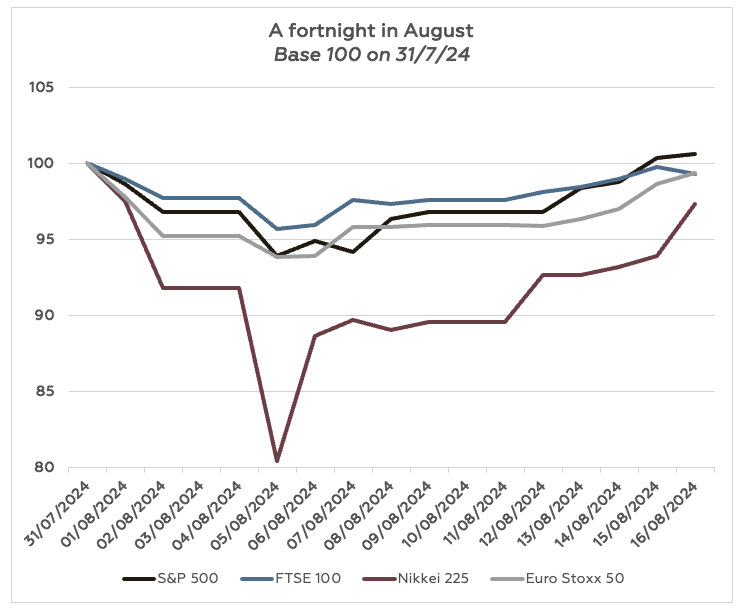
August started with sharp gyrations on global stock markets. It was a good time to be on holiday.

Source: Investing.com  

It was once suggested that a wise approach to investment in the stock market is to make your choice and then go away to a remote desert island with no communication links for at least three – or preferably five – years. This drastic prescription, which predates the internet era, was meant to stop the investor from watching markets day-to-day, worrying about any temporary falls and making changes that would later prove ill-judged. The logic underpinning the recommendation remains true today: investment in shares is for the long term and what happens in the short term is often best ignored as nothing more than noise.

In a much shorter timeframe, if you went on holiday for the first half of August 2024, you could have experienced something very similar (provided you resisted the temptation to look at your phone). The first two days of August were consecutive days of disappointing employment data from the US. The double punch prompted concerns that the US economy was headed for a recession, even though it had grown at a healthy annualised rate of 2.8% in the second quarter of 2024. The second set of employment figures showed the US had created 114,000 new jobs in July, which was much lower than expected but higher than the (revised) figure for April. Unfortunately that figure emerged on a Friday, giving those prone to panic the chance to spend the entire weekend fretting that the US economy was about to crash, dragging the world economy with it.

On Monday 5 August, amid speculation that the US Federal Reserve would have to make an emergency rate cut of at least 0.5%, the Japanese stock market (as measured by the Nikkei 225) collapsed by over 12%. On the following day, there was a change of heart and the Japanese market rose by over 10%. Thereafter, a calmer mood prevailed, aided by better US employment data on Thursday 8 August. As the graph shows, by Friday 16 August the US market (represented by the S&P 500) was higher than at the end of July and Japan was down, but by less than 5%.

As a lesson in ignoring the noise in favour of the beach, it could not have been a better example…

The value of your investment and any income from it can go down as well as up and you may not get back the full amount you invested.
Past performance is not a reliable indicator of future performance. 

Investing in shares should be regarded as a long-term investment and should fit in with your overall attitude to risk and financial circumstances.

Ciarán Madden
Opening the books – the government’s spending inheritance…

The date of the next Budget has been announced, accompanied by the new Chancellor’s warning about government finances.

Chancellor Rachel Reeves’ first announcement on entering 11 Downing Street was the commissioning of a ‘spending inheritance’ review from the Treasury. Her decision to do so was questioned by the opposition (Conservatives), among others, who argued that the state of public finances had been made clear in the report from the Office of Budget Responsibility (OBR) in March. However, the OBR’s grim outlook was studiously ignored during the election campaign by both main parties, prompting the Institute for Fiscal Studies to complain of “a conspiracy of silence”.

Post-election, the new ministers were told to ‘bring out your dead’ – pull together their departments’ financial problems. The result was a steady flow of dire warnings on prisons, the NHS, universities, and more. This was followed by a welter of gloomy reports from the National Audit Office on 23 July, publication of which had been delayed by the election.

Finally, on 29 July, Rachel Reeves bundled the bad news inside her Treasury-commissioned review and broke the IFS’s conspiracy of silence. In her words, “There were things that I did not know”, which in total represented a projected overspend of £22 billion in the current financial year. Two immediate actions she announced in response were to:

·       scrap the winter fuel allowance, other than for those on means-tested benefits; and

·       abandon the introduction of new capped social care funding rules in England, which had been due to start in October 2025.

Ms Reeves also revealed that her Autumn Budget would be on 30 October, later than had originally been expected. Her July statement made clear that there would be action on tax to fill the £22bn ‘black hole’, but reiterated Labour’s manifesto pledge that there would be no increases in national insurance, the basic, higher, or additional rates of income tax, or VAT. That points to capital gains tax, inheritance tax and tax reliefs as possible revenue-raising targets in the autumn.

If you are considering any financial planning in the near term – perhaps pension contributions or gifts to grandchildren – talk to us about the wisdom (or otherwise) of acting before 30 October.  

Tax treatment varies according to individual circumstances and is subject to change.

The Financial Conduct Authority does not regulate tax advice.

Tax treatment varies according to individual circumstances and is subject to change.

Ciarán Madden
Prepaying/repaying student loans

Are student loans something to avoid?

With the 2024/25 academic year on the horizon, student finance is again a hot topic for many parents. How hot differs slightly for the UK’s four nations as each has a subtly different way of funding students and, outside Scotland, their tuition fees. However, the broad principles are the same:

1.      Loans carry ‘interest’, usually at a rate linked to RPI inflation in March of each year (4.3% for March 2024). The rate levied can vary based on whether the student is still on their course and, if not, their level of earnings. When inflation is particularly high – as happened in 2022 – the rate may be capped at a lower ‘prevailing market rate’ (currently 7.9%).

2.     Loan repayments only begin once income exceeds a certain level. For example, for graduates in England who started their course between 2012 and 2022, the threshold in 2024/25 is £27,295. The repayment rate is 9% of income above the threshold – effectively the same as an extra 9% on income tax rates. If a graduate’s income never reaches the threshold, then they repay nothing. On the other hand, a high-flyer who ends up in an investment bank may clear their debt before reaching their thirties.

3.     Unless the loan has been fully repaid earlier, it is written off on death or at the end of a fixed term, which can be 25, 30 or 40 years, depending upon the country and the start date of the loan.

All those variables – and governments’ propensity to tweak components such as the income threshold – make the calculation of how much loan any student will repay at best a highly contingent guesstimate. The important point is that repaying all or part of a loan early, or even not drawing a loan initially, may represent an unnecessary gift to the government. ‘Paying down’ the loan does not actually impact on the amount owed, which is pegged to the earnings threshold rather than the size of the loan. The only certainty is that the person making the payment will not be able to get the money back. 

If you are considering helping a student/graduate child or grandchild to reduce their student debt, think carefully and, if necessary, take advice before acting. It may be wiser for you to help with another financial obstacle, such as the deposit for a first home.   

Ciarán Madden
Pension decisions for the new government

Autumn won’t leave much time for the new government to settle before important pension policy decisions need to be made.

When MPs return to work after the summer recess, many areas of policy will require attention. Some are inheritances from the last government, while others are of the current government’s own creation. The pensions arena provides good examples of both:

The lifetime allowance In March 2023, Jeremy Hunt, predecessor of Chancellor of the Exchequer Rachel Reeves, announced the abolition of the lifetime allowance (LTA). His action removed a £1,073,100 ceiling on the tax-efficient value of pension benefits. In her then shadow role, Reeves pledged to reinstate the LTA, saying that Hunt’s move was “a huge handout to the richest 1% of pension savers”. However, Labour’s manifesto in June included no mention of the LTA’s resurrection, prompting speculation that the idea had been dropped. To complicate matters further, the legislation scrapping the LTA is faulty and requires amendment. Clarification on all counts is needed in the forthcoming Budget.

State pension age The decision on when the State pension age (SPA) should rise to 68 has been deferred twice. Each time the decision was delayed until after an impending election. The last deferral moved the decision deadline to July 2026. Not unreasonably, the previous government had said it would give the public ten years’ notice of any SPA change. The new government now finds itself boxed in, unable to defer any further, as the original recommendation in the 2017 Cridland Report was to start phasing in the new SPA from April 2036.

Automatic enrolment The last government set a target date of the mid-2020s for reducing the minimum age for auto-enrolment from 22 to 18 years, and increasing contributions. However, the 2023 legislation responsible for this change has not yet been enacted. The government faces a difficult balancing act here, as reform would mean better pension provision, but higher costs for employers, greater pay deductions for employees and more tax relief paid out by the Treasury.

None of the above should mean you pause your retirement planning. You are likely to have at least reached retirement if you want to wait for a reform-free pension period before taking action.

Tax treatment varies according to individual circumstances and is subject to change.

The Financial Conduct Authority does not regulate tax advice.

The value of your investment and any income from it can go down as well as up and you may not get back the full amount you invested.

Ciarán Madden
Help your favourite charity and save tax

‘Tick the Gift Aid’ box to boost your donation to charity and save some tax.

The number of national and international calls on our goodwill to donate to causes has grown in the last few years. You are probably familiar with the ‘Tick the Gift Aid’ box, or a request to sign a declaration, when you donate to charity. As a rule, it makes sense for you and the charity to do so. This simple step could mean a £100 gift costs you only £40 (or £32.50 in Scotland).

When donating with Gift Aid, the charity can reclaim £2 of tax from the government for every £8 you donate. The only constraint is that you must have paid at least as much income tax or capital gains tax in that tax year as the charity will claim. For instance, if you gift £800 and the charity reclaims £200, you will need to have paid £200 in tax.

If you pay tax at more than basic rate, gifting allows you to reclaim some tax. For example, let’s revisit your £800 gift. If you have at least £1,000 of income taxed at 40%, then you can personally reclaim £200 (£1,000 x (40%–20%)). This increases to £250 for 45% taxpayers. However, the process is not automatic and you must remember to make a reclaim, usually through your tax return.

The tax relief mechanics of Gift Aid donations can provide other tax benefits because the amount of your gift, plus the tax reclaimed by the charity, counts as a deduction in calculating your ‘adjusted net income’. This income figure is used in three important income thresholds:

·       High income child benefit charge between £60,000 and £80,000 (£50,000–£60,000 in 2023/24);

·       Tapering of the personal allowance between £100,000 and £125,140; and

·       Entitlement to tax-free childcare, which is completely lost at £100,000+.

A good – if somewhat extreme – example would be Joe, who has an income of £102,000 and makes a donation of £1,600 (equivalent to £2,000 for the charity after its tax reclaim). The gift reduces Joe’s adjusted net income to £100,000, so he would:

·       Recover £1,000 of the personal allowance, saving £400 (£450 in Scotland) in tax on top of £400 (£500) reclaimable as a higher (advanced) rate taxpayer; and

·       Regain entitlement to tax-free childcare, assuming his partner/spouse did not break the income threshold.

Tax treatment varies according to individual circumstances and is subject to change.

The Financial Conduct Authority does not regulate tax advice.

Ciarán Madden
The taxpayer club – have you joined?

New data from HMRC show growing numbers of income taxpayers paying above the basic rate.

Source: HMRC

The club that all members want to leave, the income tax playing club, is gathering ever more members who are paying every greater subscriptions. That, at least, is one way of looking at some updated statistics which HMRC published in the final week before the election. Curiously, the main parties ignored the data, reinforcing what the independent Institute for Fiscal Studies described as an election-time “conspiracy of silence” on the true state of government finances.

The HMRC data, which included projections for the current tax year, showed:

·       The taxpaying population has risen to 37.4 million in 2024/25, 6.2 million more than in 2019/20. That 20% increase is primarily the result of the freezing of the personal allowance (£12,570 since April 2021) and recent high inflation (21.3% between April 2021 and April 2024). The sharp rise in the taxpaying population could help explain some of the administrative problems HMRC have experienced. 

·       Higher rate taxpayer numbers are projected to be 6,310,000 in 2024/25, just over one in six of all taxpayers. As recently as 2010/11, that proportion was less than one in ten. The current tax year’s figure would have been even higher, but for the Scottish government’s decision to introduce a new tax rate, advanced rate at 45%, for 2024/25. HMRC has classified advanced rate taxpayers as additional rate taxpayers in their UK-wide statistics, even though their income would make them higher rate taxpayers outside Scotland. Without that change, the higher rate numbers would have been 114,000 greater, based on Scottish Budget estimates.

·       Those Scottish advanced rate taxpayers also explain some of the 180,000 jumps in the additional rate taxpayer numbers for 2024/25 to 1,130,000 – 3% of all taxpayers. In 2010/11, when the additional rate was introduced (at 50% on income over £150,000), the corresponding proportion was just 0.75%. The threshold was cut to £125,140 from April 2023.

The precarious state of government finances means that the freezes on the personal allowance, and higher and additional rate thresholds are unlikely to disappear before at least April 2028. That provides a good reason for making sure that your investments are structured in the most tax-efficient ways available.

Tax treatment varies according to individual circumstances and is subject to change.

The Financial Conduct Authority does not regulate tax advice.

Ciarán Madden
Take a deep breath in a year of elections

Market responses to elections should be treated with caution.

Source: Investing.com

2024 is a year of elections around the globe – in varying shades of democracy. On some counts, around 60 countries will vote, representing close to half of the world’s population. This includes eight of the world’s most populous nations – Bangladesh, Brazil, India, Indonesia, Mexico, Pakistan, Russia, and the United States. June saw European Parliament elections, followed rapidly by the surprise calling of French parliamentary elections. By chance, the two polling days for those elections straddled the UK general election on 4 July.

The big election of 2024 is the US presidential election due on 5 November. If the six weeks of the UK’s general election seemed agonisingly long, you can understand why Americans, with their one-year-plus campaigns, feel envious of our democratic process. Even once the US votes are in, it will not be until 20 January 2025 that the new president is inaugurated – if all goes to plan this time.

Investment markets take a close interest in political developments, but their guess is as good as ours at divining what impact the results will have and how to react to them. On long-term visualisations of major global stock market indices, it’s virtually impossible to detect the changes of government along the paths of jagged lines without the help of parliamentary term shading.

In the short term, market responses can be simply reactive. This was demonstrated in the world’s largest election of 2024, which took place in India over seven phases between 19 April and 1 June. When the results were announced on 4 June, they were, in the words of The Economist, ‘A shock election result’. As the graph above shows, the Indian stock market, as measured by the BSE Sensex Index, dived over 5.7% on the results day, having risen 3.4% the previous day. The ‘shock’ proved short-lived and three days later, as the political situation became clearer, the BSE Sensex was back above its pre-election level.

For investors, it is arguable that politics is just noise. To borrow a long-ago US political soundbite, ‘it’s the economy, stupid’, not politics, which has greater relevance.

The value of your investment and any income from it can go down as well as up and you may not get back the full amount you invested.

Investing in shares should be regarded as a long-term investment and should fit in with your overall attitude to risk and financial circumstances.

Ciarán Madden
Greenwashing clampdown on investment funds

New rules have come into force governing the claims made by sustainable funds.

As sustainable investing has grown in popularity, the issue of ‘greenwashing’ has moved into the spotlight. However, investors, turned fund detectives, have discovered that funds with ‘sustainable’, ‘environmental’ or similar labels are buying shares in companies which do not match the branding. Elsewhere, some sustainable funds seem to differ little from their ordinary counterparts, with perhaps just the obvious red flags, such as the oil majors, excluded.

At the end of May 2024, new Financial Conduct Authority (FCA) rules took effect designed to bring clarity to the sustainable investment sector. These require any reference to sustainability in product or service to be:

·       Correct and capable of being substantiated: In other words, a product or service should do what it says on the tin. Any business promoting a sustainable product/service must be satisfied that there is suitable evidence to support the sustainability claims being made. Both the claims and the supporting evidence must be regularly reviewed.

·       Clear and presented in a way that can be understood:  Investment is prone to the use of jargon and sustainability can add another layer of opaque prose. The FCA wants any claims made to be ‘transparent and straightforward’. That can mean different things to different audiences, so one-size descriptions may not fit all. The regulator says that clarity extends to the images, logos and colours that are used, which could mean less green ink and fewer rainforests in marketing material.

·       Complete – they should not omit or hide important information and should consider the full life cycle of the product or service: This requirement is designed to prevent the sustainable aspects of an investment from being highlighted, while suppressing or omitting less attractive features. The FCA gives an example of an investment financing energy efficiency improvement without also explaining that funds may be used to improve the efficiency of fossil fuel production and distribution.

·       Comparisons to other products or services are fair and meaningful: Any claims making comparisons of the sustainability characteristics of products/services should be clear about what is being compared, how the comparison is being made and should only compare like with like.


For more information on sustainable funds meeting these new requirements, please contact us.

The value of your investment and any income from it can go down as well as up and you may not get back the full amount you invested.

Investing in shares should be regarded as a long-term investment and should fit in with your overall attitude to risk and financial circumstances.

Ciarán Madden
Heading down on interest rates?

Central banks around the world are beginning to cut interest rates with the European Central Bank leading the way.

Source: US Federal Reserve, Bank of England, European Central Bank

On 6 June 2024, the European Central Bank (ECB) became the first major central bank (the big three being the US, UK and European) to announce an interest rate cut in the current cycle. This marked the ECB’s first cut since September 2019, when its main rate was reduced to a negative rate of -0.5%. ECB President Christine Lagarde hinted at a June cut for some time, so the move came as no surprise. She has been more guarded about future reductions, which suggests June’s move does not herald the start of regular cuts at each meeting.

Two weeks after Lagarde’s cut, her counterpart at the US Federal Reserve (the Fed), Jerome Powell, also produced an unsurprising interest rate announcement: no change. At the same time, the Fed’s rate-setting committee released its quarterly projection of interest rate falls for the next two years – using forecasts from its members. The detail is summarised in what the investment community calls the ‘dot plot’ and suggests only one cut of 0.25% by December 2024, followed by another four in 2025.

Eight days later, the Bank of England, led by Andrew Bailey, repeated Powell’s no-change mantra. While the Bank denies its decisions are influenced by politics, like the Fed, it was understandably wary of making interest rate changes close to an election. The Bank also faces a problem that the Fed and ECB do not: average earnings growth of around 6%. In the view of most economists, and the Bank, a 6% rise in earnings is incompatible with 2% inflation – the Bank’s target. Even so, after the Bank’s decision in June, the money markets were pricing in a near-even chance of a cut at the beginning of August.

If you have been accumulating cash on deposits earning an interest rate usefully above inflation, now may be the time to consider investing that capital. The period of higher-for-longer interest rates may not last for much longer.

The value of your investment and any income from it can go down as well as up and you may not get back the full amount you invested.

Past performance is not a reliable indicator of future performance.

Ciarán Madden
Light my FIRE – could you really retire early?

Do you dream of retiring much earlier than your peers?

Many ideas which originated in the US have made their way across the Atlantic. The latest financial innovation to join index-tracking investments, budgeting apps and exchange traded funds is the FIRE movement – Financial Independence, Retire Early.

If you are a millennial or a member of Gen Z (born between 1997 and 2012) and not enjoying your working life, then FIRE has an obvious appeal. At the most extreme are people in their 20s, hoping to retire in their 30s or early 40s. That is a challenge in the UK given the current minimum age to draw a private pension is 55, soon to rise to 57, while the State pension now begins at age 66, increasing to 67 by April 2028.

Maximising savings

The FIRE movement revolves around saving enough from earnings (and any side hustles) to accumulate capital of about 25 to 30 times yearly expenses by retirement. The 25–30 multiple is driven by another US import – the concept that drawing 3%–4% a year from capital is a low enough level to be sustainable throughout life. To put that in context, the Pension and Lifetime Savings Association says the current minimum annual income level needed by a retired couple is £22,400, implying a FIRE capital target of £560,000–£670,000.

While the lure of FIRE is the promise of early retirement, its pre-retirement requirement may not be so attractive. The regular savings goal needed to fill up the retirement pot necessitates a minimalist lifestyle for most people. For example, to accumulate £600,000 in 15 years needs monthly savings of £2,275, assuming a net investment return of 5% a year. Add to that such imponderables as job security and inflation. If you had started in January 2009 with a £600,000 goal, then in terms of January 2024 buying power your pot would need to be nearly £930,000. No wonder there are stories of some FIRE enthusiasts who start out aiming to save 70% of their income.

Realistically, for all but those with the highest income who are content with the lowest standard of living, FIRE is more smoke than substance. The message of maximising your retirement savings where possible is, however, a useful takeaway.

Ciarán Madden
From victory to Budget? Labour’s first 100 days

With a majority of over 200 and a weight of expectations, what happens next for Sir Kier Starmer’s new Labour government?

The importance of the first 100 days of a new government cannot be understated. Within that period the new incumbent has the greatest political capital to take bold actions, as well as the greatest opportunity to lay the blame for ‘inherited’ problems on its predecessor.

Given the timing of the election, Labour’s first 100 days are a little complicated and will look something like this:

17 July This date has been set for the State Opening of Parliament and the King’s Speech. Before then parliament will have gone through the process of electing a Commons Speaker and swearing in the fresh intake of MPs.

The King’s Speech will provide an insight into the new government’s immediate priorities and could reveal the first surprises.

Early August? The House of Commons was due to start its summer recess on 23 July before the election was called, but that would not leave enough time for the debate of the King’s Speech. Unless the summer recess is delayed, the new government won’t have time to get to work on those commitments.

13 September Presuming one of Chancellor Rachel Reeves’s first acts was to give notice to the Office for Budget Responsibility on 5 July to start preparing its Economic and Fiscal Outlook, then – perhaps ominously – Friday 13 September would be the earliest date she could give her Budget. However, speculation is growing that there will be no Budget before October. One reason is 22 September...

22 September The Labour Party conference in Liverpool runs from 22–25 September 2024. Previously parliament has had a three-to-four-week recess to cover the conference season. The new government may reduce the length of this recess, although it is unlikely that Labour MPs will be at Westminster rather than at what is set to be a victory conference.

12 October Counting from 5 July, 12 October will mark the end of Labour’s first 100 days. As suggested, we could still be waiting for Rachel Reeves’ first Budget. At her first speech and press conference at the Treasury on 8 July, she confirmed she will present an interim report to Parliament on the state of the government’s finances, or Labour’s “spending inheritance”, before the recess, with the Budget to come later. She may combine her fiscal premiere with the announcement of the Spending Review as the two are closely related.

Tax treatment varies according to individual circumstances and is subject to change.

The Financial Conduct Authority does not regulate tax advice.

Ciarán Madden
How to raise tax revenue without raising tax rates

As we count down to the general election in July, be wary of those manifesto promises not to raise tax rates.

The Conservatives and the Labour party are going into the next election with the same key fiscal rule. This states that in five years’ time, total government debt (currently about £2,700 billion) should be falling as a percentage of gross domestic product (GDP), which is broadly how much the UK produces in a year. It is a rolling five-year target, which means the test is purely theoretical, based on economic projections from the Office for Budget Responsibility (OBR).

However, after the election, there is going to be a much more immediate – and real – problem: the new government will need to undertake a Spending Review as the existing Review (2022–2025) ends in April 2025. This is likely to be a painful process – the head of the OBR has described the financial plans outlined by the government for 2025 onwards as worse than ‘a work of fiction’.

With both major parties avoiding discussion of raising tax rates, it may seem the only option is spending cuts to bring finances into balance, but that is not necessarily the case. As the current government has demonstrated with its tax allowance freezes and cuts, increasing tax revenue does not require tax rate rises. Another Exchequer-boosting possibility, which was floated by the Shadow Chancellor, Rachel Reeves, in 2021 is to cut back on tax reliefs. At last count, HMRC said that there were nearly 1,200 tax reliefs in force.

Recently, the Institute for Fiscal Studies (IFS) gave an example of how reforming just three inheritance tax (IHT) reliefs could, in the short term, increase tax receipts by £3.6 billion a year. The trio of changes proposed by the IFS were:

·       Abolishing 100% IHT business relief for AIM shares;

·       Limiting business and agricultural reliefs to a total of £500,000 per person; and

·       Scrapping the IHT exemption currently given to pensions pots on death.


There are plenty of other areas where revising or scrapping tax reliefs could prove rewarding for a cash-strapped Chancellor, but do not expect to see them listed in the forthcoming manifestos.


Tax treatment varies according to individual circumstances and is subject to change.

The Financial Conduct Authority does not regulate tax advice.

Ciarán Madden