Risk and reward

The government wants to encourage investment, not savings.

“For too long, we have presented investment in too negative a light…quick to warn people of the risks, without giving proper weight to the benefits…”

These words may sound like the rhetoric of the chief executive officer of a fund management company, but they are not. In fact, they belong to the Chancellor, Rachel Reeves, and formed part of her recent Mansion House speech. Earlier in her speech, she said, “I am rolling back regulation that has gone too far in seeking to eliminate risk.” For April 2026, she promised a campaign to promote the benefits of retail investment, funded by the financial services industry.

If you have become accustomed to all the small print warnings that accompany almost anything financial, you may be wondering what is going on. Has the government suddenly switched from consumer protection to buyer beware? The answer is no, but:

·       The financial services industry is a member of the eight ‘growth-driving sectors’ that formed part of the government’s recently launched 10-year industrial strategy, and the one that falls most clearly into the Chancellor’s remit.

·       The UK’s standing in global finance has been declining in recent years, with events like Brexit and the Liz Truss mini-budget calling into question the nation’s financial stability. The current government, like its predecessor, wants to reverse that decline.

·       The government does not have the resources to make all the large industrial and infrastructure investments that UK plc requires. Borrowing more to fund the investment – yet alongside raising more tax – would be dangerous, both economically and politically. Consequently, the Chancellor is turning to private investors, both individual and institutional, such as pension funds.

·       Rachel Reeves has long been trailing the idea that she wants to “improve returns for savers” by, for example, reducing the amount that can be placed in cash Individual Savings Accounts and pushing pension fund investment in private markets.


The Chancellor clearly has the view that reducing financial regulation and encouraging more risk-taking will be good for the financial services industry and economic growth. It is a strategy which should stimulate more investment, but one that makes professional advice even more important.
Ciarán Madden
Two views of the State pension

The future of triple lock increases for the State pension has been called into question by two well-respected groups of economists.

Triple lock increases to the main State pension were introduced from 2011/12, setting the yearly April increase at the greater of:

·       The rise in prices to the previous September, now as measured by the Consumer Prices Index (CPI).

·       The rise in average earnings (including bonuses) to the previous July.

·       2.5%.


The primary unspoken aim was to gradually raise the level of the State pension, relative to prices and earnings. A secondary goal was to avoid a repetition of the inflation-linked pension increase of just 75p a week in 1999, which attracted considerable political flack.


At the time of the triple lock’s introduction, the Office for Budget Responsibility (OBR) projected that by 2029/30 it would be costing £5.2 billion a year more than if increases had been solely linked to earnings growth. Unfortunately, that proved to be one of the OBR’s more inaccurate projections.

In a daunting document entitled ‘Fiscal Risks and Sustainability Report’, the OBR now projects that the extra cost will be £15.5 billion in 2029/30, almost exactly three times its original figure. The OBR says that its original projection assumed a few years in which the triple lock would outpace earnings. However, the reality was that since the start of the triple lock, the UK has seen more volatile inflation and lower earnings growth than the two decades prior to the triple lock’s introduction (which had guided the OBR assumption). Looking far forward to 2073/74, the uncertainty surrounding what payments will be triggered by the triple lock encouraged the OBR to include three potential cost estimates for pension uprating, with £48 billion in today’s money being the OBR's most likely outcome.

Meanwhile, at the Institute for Fiscal Studies (IFS), economists have produced a pension report that also highlights the high cost of the triple lock. The IFS says “a reasonable estimate … for additional spending on the state pension in 2050 due to the triple lock, above and beyond earnings indexation, would be between £5 billion and £40 billion a year in today’s terms.”

After the problems caused to the government by means-testing the Winter Fuel Payment, the triple lock should be safe for the rest of this Parliament. Thereafter, it would be unwise to assume its prolonged survival in your retirement planning.

Ciarán Madden
Company car popularity rises

New research from HMRC show company cars are becoming more common – and greener.

Source: HMRC

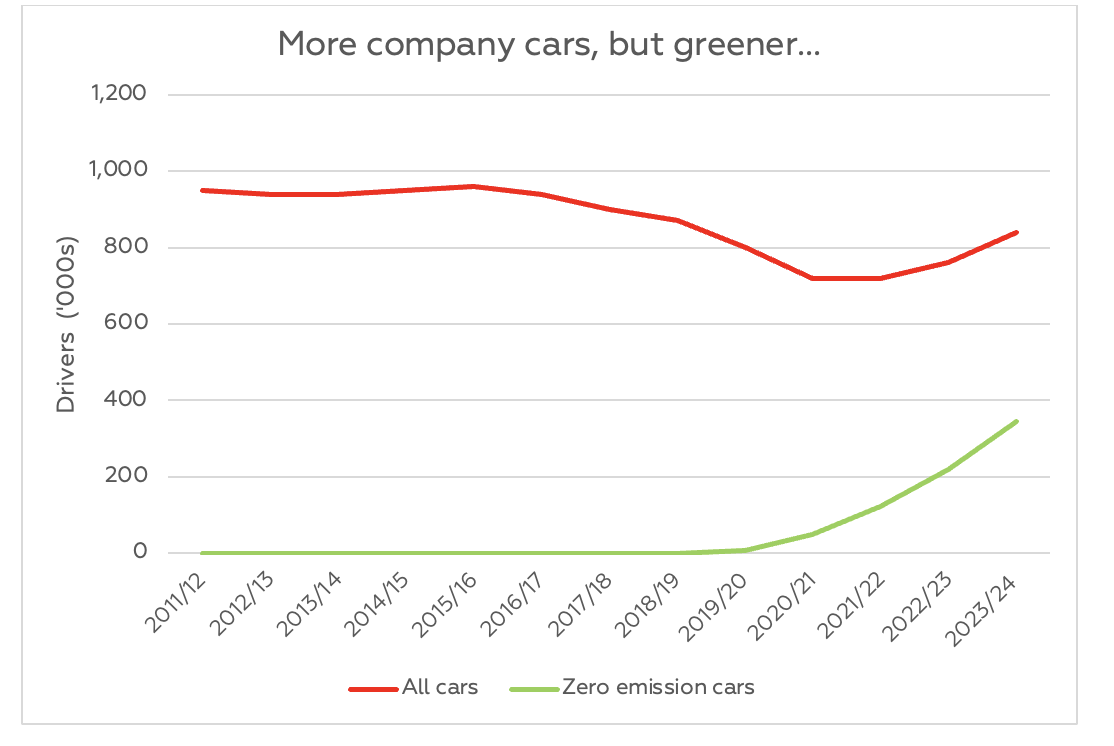
Recent statistics issued by HMRC show that company car ownership (the top line) is enjoying a revival after a 25% fall between 2015/16 and 2020/21. The reason for the increase is largely explained by the second line, which shows electric company car ownership.

As recently as 2018/19, less than one company car in two hundred was a zero-emission vehicle:

·       By 2023/24 (the latest data), the proportion had changed to about two in every five.

·       Over the same period, the diesel share of the company car population dropped from over two in three to just one in eight.

The switch to green does not signify that company car drivers are becoming environmentalists over the decade. Instead, it is a clear demonstration of how tax changes can drive behavioural change:

·       In April 2017, HMRC introduced a new approach to taxing company cars that were provided under salary sacrifice or similar arrangements. In many instances, the new regime, called Optional Remuneration Arrangement (OpRA), made salary sacrifice less attractive because it ended up basing the personal tax on the company car regime rather than, as previously, the amount of salary foregone. To encourage take-up of low-emission cars, an exclusion was carved out for cars with CO2 emissions of up to 75g/km (of which there were very few at the time).

·       In 2020/21, the benefit-in-kind percentage charge on zero-emission cars was cut from 16% to 0%. Thereafter, for the next two years, it rose by 1% a year, reaching 2% in 2022/23 and staying at that level until a further 1% rise to 3% for the current tax year, 2025/26. In contrast, a petrol car with 100g/km of CO2 emissions saw its scale percentage rise marginally from 24% in 2019/20 to 25% currently.


The combination of inducements has proved almost too successful: the total taxable value of all company cars fell from £5.43 billion in 2019/20 to £3.27 billion in 2023/24. Now, however, the percentage scale charge for zero-emission cars is on the increase and by 2029/30, it will be 9% – three times the current level. It may still be worth considering salary sacrifice for an electric company car, but the tax calculations will not be as favourable.

Tax treatment varies according to individual circumstances and is subject to change. The Financial Conduct Authority does not regulate tax advice.

Ciarán Madden
Unloved LISA

With changes to Individual Savings Accounts (ISAs) expected in the Autumn Budget, one existing variant has been heavily criticised by the Treasury Select Committee.

The Lifetime ISA (LISA) made its debut in George Osborne’s final Budget in March 2016. At the time, it appeared to be a proposal for a new form of pension savings product and the potential precursor to a radical overhaul of the pension tax regime. After Osborne was replaced by Philip Hammond in the wake of the Brexit vote, it was doubtful whether the LISA would come into existence. Nevertheless, it was eventually launched in April 2017.

Many ISA providers decided to give LISA the cold shoulder. The product was seen as too complex and difficult to advise on. Eight years on from its launch, only one in seven ISA providers also offer LISAs. It was probably LISA’s mediocre success that caught the attention of the Treasury Select Committee at the start of this year.

At the end of June, the Committee issued its report, which highlighted several problems with LISAs, including:

·       The early withdrawal charge: This is levied at 25% of the amount withdrawn, clawing back more than the bonus given on each contribution. In 2023/24, HMRC collected £75 million of early withdrawal charges, a level which the Committee thought “may indicate that the Lifetime ISA is not working as intended”.

·       Dual purpose structure: LISA withdrawals can be made charge-free from age 60, or if the funds are used towards the purchase of a first home, valued at up to £450,000. These two goals – one long term, the other short term – would normally require different strategies of investment, but some LISAs are only available as cash plans, with no stocks and shares component.

·       Cost to the Exchequer: Although the maximum annual LISA subscription is only £4,000, the total cost to the government of the 25% subscription bonus is projected to be about £3 billion over the five years to 2029/30. At a time when the Chancellor is scrabbling for every penny, the Committee questioned whether LISAs were good value or an unnecessary handout.

The Committee’s report could sound the death knell for new LISAs, so if you want to invest in one, act soon – but only after taking advice, as there may be better options.

The value of your investment and any income from it can go down as well as up and you may not get back the full amount you invested.

Investing in shares should be regarded as a long-term investment and should fit in with your overall attitude to risk and financial circumstances.

Tax treatment varies according to individual circumstances and is subject to change. The Financial Conduct Authority does not regulate tax advice.

Ciarán Madden
Will reform proposals – time to revise Victorian rules

The Law Commission has made a variety of proposals to reform the law governing wills in England and Wales.

What were you doing in 1837?

Of course, the question is rhetorical. For you, the reader, were clearly not born then and, unless your hobby is genealogy, you would struggle to name any distant family members alive at that time. Yet, your family member was, and you currently are, both subject to the Wills Act 1837. In the intervening 188 years, the Act has been subject to amendments, but some of its early Victorian contents have survived.

Arguably, not before time, the Law Commission recently issued a comprehensive report making recommendations to create a Wills Act for the 21st century. Its proposals include:

·       Enabling electronic wills: Paper was the order of the day in 1837, not digital screens. The Law Commission recommends that electronic wills should be valid, subject to suitable protection for the person making the will (the testator) and appropriate security for the will.

·       Ending will revocation on marriage or entering a civil partnership: In England and Wales (also, Northern Ireland, but not Scotland), a will is normally automatically revoked on marriage. Few people are aware of this, which can lead to couples thinking that the words written during cohabitation are valid after the wedding bells have rung. At the other end of life, there is the issue of ‘predatory marriages’ when one party marries, knowing that they will benefit from intestacy rules when their older partner dies without having made a fresh will. 

·       Reducing the minimum age at which a person can make a will: Currently, in England and Wales (again, Northern Ireland), generally, a person must be 18 years old to make a valid will. In Scotland, the minimum age is just 12 years of age. English law presumes that children from age 16 have the capacity to make a range of decisions, but not to create a valid will. The Law Commission wants anyone aged 16 and above to be able to make a will.

These and other proposed changes have been incorporated into a draft bill before Parliament. It is now up to the Government to decide whether to implement the recommendations, which could take a year or more. That is no excuse to procrastinate: a will, even governed by a nearly 200-year-old act, is better than no will.

The Financial Conduct Authority does not regulate will advice

Ciarán Madden
The return of the Winter Fuel Payment

The Winter Fuel Payment will be returning for most pensioners in England and Wales this winter.

Two days before her important Spending Review announcement, Chancellor Rachel Reeves largely completed a slow-motion U-turn on eligibility for the Winter Fuel Payment (WFP). In July 2024, one of Reeves’ first actions as Chancellor was to limit those entitled to the WFP to households in England and Wales in which someone was claiming pension credit or certain other benefits. It was a controversial move, which took away the payment from almost 90% of pensioners (aged 66 and above), saving a projected £1,500 million for the Exchequer.

The change to eligibility announced in June means that only pensioners in England and Wales with income exceeding £35,000 a year (around two million in number) will be ineligible for the WFP in the coming winter. To achieve this, the government has borrowed an approach it uses for High Income Child Benefit Charge. If your income is over £35,000, then you can either:

·       Receive your WFP – and have it clawed back by HMRC via your PAYE code or self assessment; or

·       Make a WFP opt-out request to the DWP.

The second choice may not be available in time for this winter as no DWP system exists at present.

Mixing a household entitlement (WFP) with an individual-based tax system creates a further complication, which has been addressed by ‘sharing’ the WFP. For a couple aged under 80 where only one spouse has income over £35,000, the lower income spouse will be entitled to a WFP of £100 (£200/2) while their partner will have no entitlement. Sharing produces its own anomalies: a couple with £100,000 joint income split 70/30 will be entitled to a 50% WFP, while a couple with an income of £70,002 evenly divided will have no entitlement. 

The partial reinstatement of the WFP will cost the Treasury £1,250 million, the funding for which the Chancellor has not yet explained. Had there been no capping of entitlement at £35,000, the bill would have been £450 million more. Scotland and Northern Ireland have their own devolved winter fuel arrangements and Scotland has already announced it will broadly follow Reeves’ approach.

Footnote: If you are thinking £200/£300 does not sound much, that is because those amounts were set in 2003/04. Inflation adjusted, WFP is now nearly 80% higher.

Ciarán Madden
Another Parliament, another Pension Schemes Bill

A new pensions bill has been introduced, which could affect your existing pensions.

Pension legislation is almost a staple of parliamentary business. If it is not the Chancellor tweaking the tax rules, it is the Department for Work and Pensions (DWP) revamping the framework of private or state pension arrangements. In June, it was the turn of the DWP to introduce a 114-page bill which, like many bills these days, left most of the fine detail to future regulations.

The latest Bill heralds some far-ranging reforms that could change your existing pension arrangements:

·       Consolidation The government wants to see a major shrinkage in the number of defined contribution (DC) funds into which most employer and employee contributions now flow. To achieve this, the bill requires, with limited exceptions, that the main default investment fund of multi-employer schemes have a value of at least £25 billion by 2030. That goal implies that many existing schemes will be merged to form ‘megafunds’, bringing the UK in line with Australian practice.

There are similar provisions (without the £25 billion threshold) to consolidate the default funds of contract-based schemes (e.g., group personal pensions). 


·       Small pots One of the problems created by the success of automatic enrolment in workplace pensions is that job-changers can end up with a ragbag of small pension pots, which are not cost-efficient for employees or pension providers. The Bill gives the government the power to consolidate small DC pension pots of up to £1,000 into a single scheme certified to offer good value. However, full implementation is unlikely until after 2030, once the megafunds market is established.


·       Investment in private assets One of the justifications for the creation of megafunds is that their size will permit investment in a wider range of assets, including specialist private markets such as venture capital, infrastructure, property and private credit. These are all areas where the government wants to stimulate UK investment but lacks the finances to do so directly. The Bill gives the government a reserve power to require megafunds to invest a minimum amount in these specialist areas. Background papers show the minimum is currently planned to be 10%, of which at least half must be in the UK.


These changes will take their time to work through, but by the early 2030s your pension arrangements could be very different from today.


The value of your investment and any income from it can go down as well as up and you may not get back the full amount you invested.


Past performance is not a reliable indicator of future performance.  

Ciarán Madden
How much retirement income do you need?

New research suggests some retirement costs have fallen, but there is a twist…

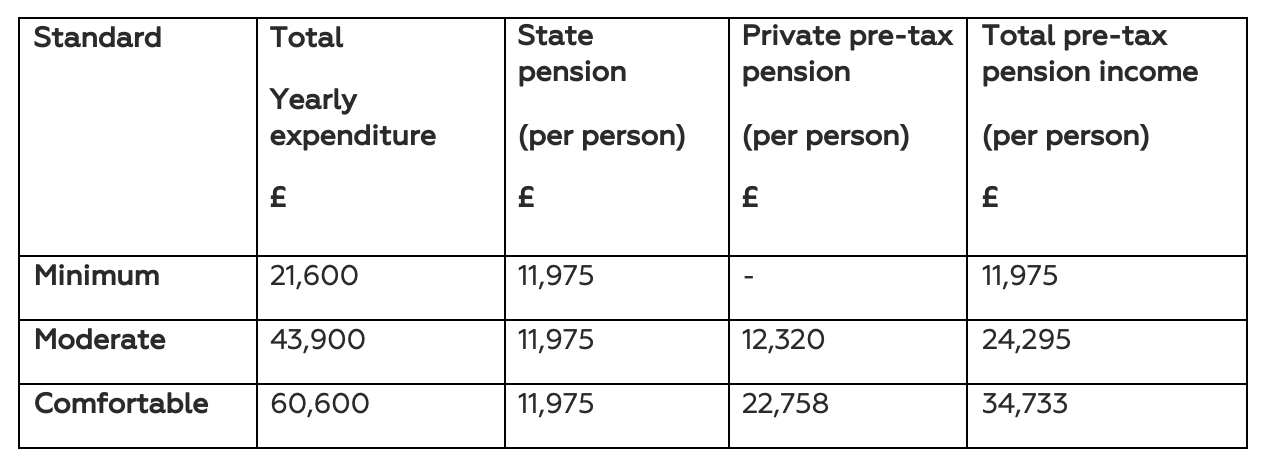
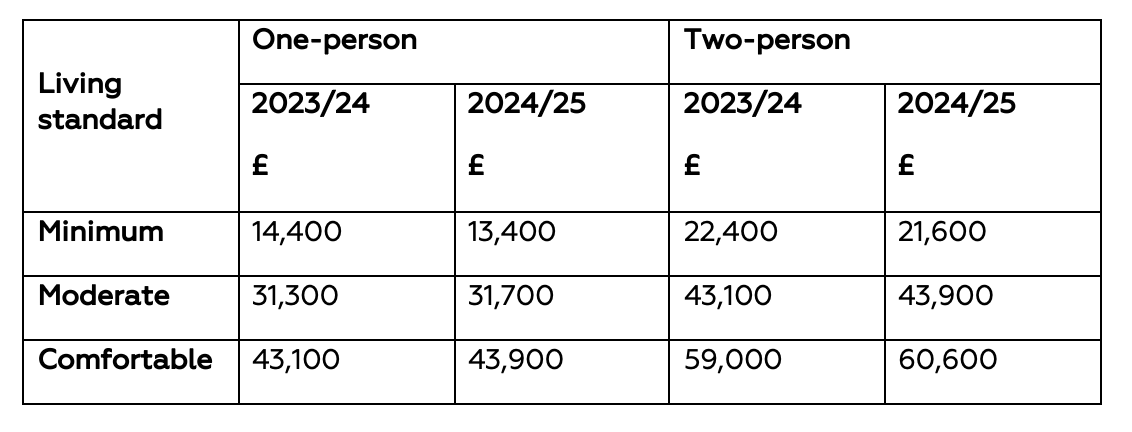
How much net income do you need each year for a minimum, moderate or comfortable living standard in retirement? Every year since 2019, the Pension and Lifetime Savings Association (PLSA), working in conjunction with Loughborough University, has provided the answer. In June, the PLSA published the latest calculations:

Table 1: PLSA income calculations on living standards 2023–2025

Source: PLSA

These figures are based on people living outside London; if you are in the metropolis, you can add between £1,300 and £3,200 a year for the privilege.

One notable change from 2023/24 is that the minimum standard figures have dropped significantly. The reason for this is somewhat arcane and now history. The PLSA figures are based on an April date, which means the 2024/25 figures benefited from the sharp fall in energy costs between April 2023 and April 2024. Since April 2024, energy costs have risen: the April 2025 Ofgem price cap was 9.4% higher than its April 2024 counterpart.

In any case, the chances are that you would not choose the minimum standard. In the words of the PLSA, the minimum standard “covers all your needs, with some left over for fun”. However, the fun is rather limited – the minimum standard assumes no car, a single week’s holiday in the UK and £30 a month per person spent on eating out. You would almost certainly prefer the comfortable standard, with a three-year-old small car, a fortnight four-star, half-board Mediterranean holiday plus three long UK weekend breaks, and £42 a week per person for eating out.

As Table 2 shows, the comfortable standard requires a large pension income – up to £5,225 per month after tax for two people living in London. This year, for the first time, the PLSA has spelt out the pre-tax pension required to reach each of its standards. Table 2 is for a two-person household outside London.

Table 2: PLSA income calculations on living standards 2023–2025

Now about that retirement planning review you have been putting off for so long…

The value of your investment and any income from it can go down as well as up and you may not get back the full amount you invested.

Ciarán Madden
A strangely timed report on attitudes to salary sacrifice

In late May, HMRC published a report – based on data collected in summer 2023 and dated January 2024 – that had been held back for months. Why the delay?

HMRC are not renowned for prompt action, except for issuing reminders in early April to complete a tax return. So eyebrows were raised when research commissioned in March 2023, carried out between May and August of that year, was suddenly published in late May 2025. The subject of the investigation, entitled ‘Understanding the attitudes and behaviours of employers towards salary sacrifice for pensions’, set a few next-Budget hares running.

At its simplest, salary sacrifice involves an employee giving up (sacrificing) part of their pay and their employer applying the foregone pay as a pension contribution. The employee still benefits from income tax relief on the pension contribution by not paying tax on the sacrificed pay. In addition, the approach has two benefits over a straightforward employee contribution:

·       For the employee: There is a saving in national insurance contributions (NICs) on the amount sacrificed. Broadly speaking, for basic rate taxpayers, the saving is £8 per £100 of pre-tax relief contribution, and for higher and additional rate taxpayers, £2 per £100.


·       For the employer: The saving in NICs is generally much larger at £15 per £100 of gross pension contribution. This is a higher figure now than when the research was undertaken, thanks to the controversial April 2025 increase to employer’s NICs.


The report found that “Most employers said they did not use the NI savings from the salary sacrifice arrangement to directly fund their workplace pension”, implying that they were the main financial winners of salary sacrifice. However, the survey was small – only 41 employers operating salary sacrifice were involved, with ten more that did not – and many employers do use some of the NICs to boost sacrificed pension contributions.

Part of the research outlined three scenarios of changed arrangements, which would make salary sacrifice less attractive, and measured reactions. All of them involved removing some or all of the employer and/or employee NIC reliefs. Unsurprisingly, none of the trio received a warm reception, particularly the variant that removed all NICs savings (employer and employee) and employee income tax exemption, prompting some employers to say that such changes would prompt them to end their salary sacrifice schemes.

The publication’s timing may just have been happenstance, but if you are considering salary sacrifice for pension contributions, regardless of potential changes, ensure you fully understand all the ramifications before making a decision.

The value of your investment and any income from it can go down as well as up and you may not get back the full amount you invested.

Tax treatment varies according to individual circumstances and is subject to change. The Financial Conduct Authority does not regulate tax advice.

Ciarán Madden
Will simple assessment take you by surprise?

In June, HMRC begins sending out simple assessments. They will come as a surprise to many recipients.

From June 2025, HMRC will begin to issue simple assessment letters to those who are not required to make full self assessment returns. As a rule, you will receive a simple assessment letter if you:

·       owe income tax that cannot be automatically taken out of your income;

·       owe HMRC £3,000 or more;

·       have tax to pay on your State pension;

·       either do not have a PAYE code or HMRC cannot collect the tax due via an adjustment to your code.


The letter covers the 2024/25 tax year and gives:


  • a detailed calculation of the tax due;

  • the latest date by which you must pay the tax (31 January 2026 for the 2024/25 tax year);

  • how you pay the tax;

  • what action to take if you disagree with HMRC’s numbers.


HMRC says that while some people receive a simple assessment every year, for most recipients the letter will come out of the blue. One major reason why that happens, and happens in growing numbers, is the freeze in the personal allowance. This has been fixed at £12,570 since April 2021 and is currently not due to rise until 2028/29.


The basic levels of old and new State pensions are currently (2025/26) below the level of the personal allowance. However, if you have additional State pension (which increased by 6.7% in 2024/25), it could be enough, in combination with the main State pension, to take your total State benefits over £12,570. The same could be true if you deferred your State pension(s), resulting in an increased payment.


To further complicate matters, if you owe tax on bank and/or building society interest, HMRC may send you two simple assessment letters for 2024/25, depending on when they receive the interest information. In those circumstances, any amount due on the second assessment is independent from the first.


What HMRC is likely dreading is an overall increase in the new State pension of 5% or more from the current level (£230.25 a week) before the 2028/29 tax year begins. If that happens, the new State pension alone will exceed the personal allowance, potentially dragging anyone receiving a full new State pension into tax. With inflation presently above 3% and around 5.5% earnings growth, that 5% threshold could be breached in 2026/27.

Tax laws can change. The Financial Conduct Authority does not regulate tax advice.

Ciarán Madden
Who is making your pension investment decisions?

The Government is taking an increasing interest in where pension funds are investing – or not investing.

As March’s Spring Statement underlined, Government finances are in a tight and precarious position. Precisely where the line is drawn may become apparent by the time you read this, with the results of the latest three-year Spending Review on 11 June.

Financial constraints were also squeezed under the previous government, which led the Chancellor’s predecessor, Jeremy Hunt, to launch the Mansion House Compact in July 2023. The Compact was signed by eleven major workplace pension providers, which agreed to invest 5% of their default workplace funds in private company shares by 2030. Mr Hunt aimed to finance small UK businesses without requiring fresh government support by, for example, tax incentives or subsidised loans.

Rachel Reeves made her first Mansion House Speech in November last year and, unsurprisingly, talked in similar terms to Mr Hunt about directing millions in pension funds towards UK investment. In May 2025, she launched the ‘Mansion House Accord’, building on the previous ‘Compact’. Seventeen major pension providers, accounting for about 90% of active savers’ defined contribution (DC) pensions, signed up to the new Accord. By doing so, they agreed:

·       By 2030, to invest 10% of their workplace pension portfolios in “private assets”, such as unlisted company shares, property, infrastructure and private debt.

·       That at least half their private portfolios would be ringfenced for the UK. The Treasury estimates up to £25bn of assets by 2030.

At present, the agreement is just that, but when asked whether she would make the 10% and 5% private investment levels mandatory, the Chancellor’s response was “Never say never”. There is some unease among investment managers that mandation could creep in. The current agreement signed by the pension providers does have some wiggle room – for example, the government is expected to “facilitate” a pipeline of UK investment opportunities.

In practice, meeting the private asset goals is likely to focus on investments made by default funds – those where most money flows because no other specific fund is selected. If your pension invests in a default fund, you may want to review your choice and take some investment advice tailored to your own goals, not the government’s.

The value of your investment and any income from it can go down as well as up and you may not get back the full amount you invested.

Past performance is not a reliable indicator of future performance.

Ciarán Madden
A return of inflation?

The April inflation figure was outside the Bank of England’s target range.

Source: Office for National Statistics

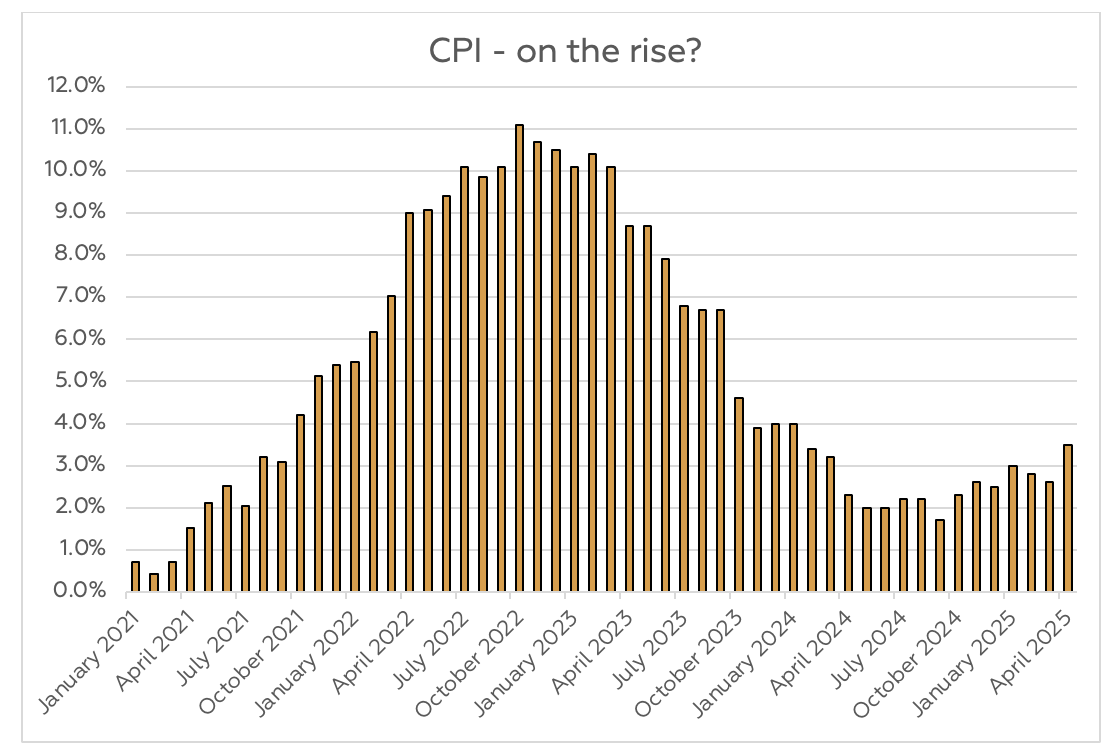
The Bank of England’s annual inflation target, set by the Chancellor, is 2%, based on the Consumer Prices Index (CPI). If inflation is more than 1% on either side of the target, the Bank’s Governor is required to write to the Chancellor explaining what has happened and the actions being taken to bring CPI back within range. If inflation is still off-target three months later, the Governor must write another letter.

Until the April 2025 inflation figures were published, the last letter that the current Governor, Andrew Bailey, had to compose was in March 2024, when the February 2024 CPI was at 3.4%. By then Mr Bailey had become well practised at such correspondence, as inflation had been above 3% since August 2021.

This year’s jump in annual inflation from 2.6% in March to 3.5% in April, which prompted Mr Bailey’s latest letter, had been widely anticipated. The Bank of England’s papers, accompanying the May interest rate announcement, showed the Bank expected April inflation to be 3.4%, rising to a peak of 3.7% by September.

Ironically, the two main drivers of the 0.9% rise were closely linked to the Government. The largest contribution was the increase in the various regional utility price caps covering Great Britain, set by OFGEM, a non-ministerial Government department. The same governmental status applies to OFWAT, which raised water bills for England and Wales by an average of 26% (with wide regional variations). The utility price cap was especially problematic because the April 2025 increase of 6.4% replaced an April 2024 decrease of around 12%.

While the recent utility-driven jump in inflation isn’t currently expected to signal a longer-term trend, it follows on from the surge of inflation earlier this decade. Cumulatively, since the start of 2020, average prices have risen by 27.7%. Had inflation remained at a steady 2.0%, the rise would have been 11.1%. If your retirement plans had assumed 2% inflation, they may now need a review.

The value of your investment and any income from it can go down as well as up and you may not get back the full amount you invested.

Past performance is not a reliable indicator of future performance.

Ciarán Madden
15.3 million people at risk of retirement poverty

New research has highlighted the groups on track for a retirement of scrimping.

Several investment institutions publish annual reports on the state of the retirement market. The latest, from Scottish Widows, does not paint a rosy picture. Its National Retirement Forecast (NRF), conducted in conjunction with a leading economic forecaster, found that:

·       39% of people aged between 22 and 65 are on track for a less-than-minimum lifestyle in retirement. In monetary terms, that equates to a net income of under £14,800 for a single person and below £23,100 for a couple. The corresponding income targets for a moderately comfortable retirement are £32,200 and £44,400.

·       27% are concerned they will have to work longer than they would like to ensure they have sufficient retirement savings, and 15% do not ever expect to be able to retire.

·       Of those saving at the minimum automatic enrolment contribution level:

-   48% are heading for a minimum retirement lifestyle,

-   35% are at risk of being unable to cover their basic needs in retirement.


The research highlights three groups with the worst retirement prospects:

1.    Generation Z (those born between 1996 and 2010): Competing financial goals make retirement savings a challenge for Gen Z. The research found 25% of people in their 20s prioritise saving for emergency expenses, while 13% are unable to save at all. The NRF projections showed that more than four in 10 people in their 20s are at risk of poverty in retirement, while almost a quarter would only be able to afford a minimum retirement lifestyle.

2.    Squeezed low to middle earners: This group has been left vulnerable by the minimum automatic contribution level. Those in their 30s on an income between £20,000 and £35,000 are the most likely to contribute at the minimum.

3.    The self-employed: The UK’s 4.4 million self-employed workers have always been excluded from automatic enrolment, and it shows. 51% are at risk of not being able to cover their basic needs in retirement with another 25% on track for a minimum retirement lifestyle. 23% are not saving anything at all, effectively relying on the State pension alone.


If you are in one of those three vulnerable groups, all is not lost. Larger contributions late on can fill the gap. But the longer you leave it, the larger they will have to be.


The value of your investment and any income from it can go down as well as up and you may not get back the full amount you invested.


Tax treatment varies according to individual circumstances and is subject to change.

Ciarán Madden
You may have missed – adult social care review slips under the radar

The first Friday of May was a busy news day. The ideal day to make an announcement that you might prefer to be overlooked – such as the Government’s new commission into adult social care in England.

The news was full of stories about the dramatic rise of Reform and the equally dramatic drop for Labour and the Conservatives on Friday 2 May, following the local election results and the first by-election of the current Parliament. There was little other news coverage – give or take an interview with Prince Harry. There was, however, a story few seemed to notice…

The Department for Health and Social Care (DHSC) chose Friday 2 May to publish the terms of reference for its independent commission into adult social care in England. The commission was first announced in early January 2025, to be headed by Baroness Louise Casey. Its launch followed Rachel Reeves’ decision in July 2024 to abandon her predecessor’s plan to cap fees for social care in England from October 2025. This scheme had already been deferred several times since its framework was set up by the Care Act 2014.

The Chancellor’s cull almost went unnoticed while focus remained on her scrapping of the universal Winter Fuel Allowance. However, the consequences were brought into stark contrast by the release of the Casey commission’s terms of reference on 2 May. This confirmed that the commission would have two separate phases:

·       Phase 1 (medium term) This phase “…set out the plan for how to implement a national care service”. In a fine piece of Whitehall speak, the terms require that “The commission’s work on medium-term reform will be a data-driven deep-dive into the current system”. Given the number of inquiries, reviews and even a Royal Commission that has examined the subject over the years, it is hard to imagine any significant new insights emerging. Nevertheless, the commission will have until 2026 to report.

·       Phase 2 (long term) This second two-year phase will look at “…how services must be organised…and discuss alternative models that could be considered in future to deliver a fair and affordable adult care system”. In other words, it will consider the question that has stonewalled every proposal to date – how to pay for care.

How long before a new system arrives? The possible answer may well lie in that choice of publication date: “The commission should produce tangible, pragmatic recommendations that can be implemented in a phased way over a decade”, which means by 2036. Meanwhile, the upper capital limit for English local authority funding support remains at £23,250, where it has been since April 2010. With no clear timeline for adult social care reform, care costs could remain a significant consideration for individuals in long-term financial planning.

Ciarán Madden
‘Yippy’ days in the markets – a new way of measuring the jitters

A new word was added to investors’ vocabulary in April.

“Well, I thought that people were jumping a little bit out of line. They were getting yippy, you know, they were getting a little bit yippy, a little bit afraid.”

So said President Trump seven days after his Rose Garden Liberation Day presentation of unexpectedly high tariffs on US imports. His words were a justification for placing a 90-day pause on most of those tariffs. However, he still left a 10% baseline tariff in place and increased Chinese tariffs to a total of 145%.

‘Yippy’ was not a word many in the markets recognised, unless they were fans of the hit football-focused series Ted Lasso. It turned out to be a golfing term, suitable for the owner of several golf courses, attributed to those whose nervousness impedes their playing ability – think of the crucial putt. In the best of Trumpian traditions, it was not altogether clear who “the people” were or what they were getting “yippy” about. However, the general interpretation was that the President was himself becoming yippy about the state of the US Treasury market.

That market, through which the US Treasury fills the gap between government expenditure and government borrowing, is worth about $28.6 trillion. To put that in perspective, the UK government bond (gilt) market is about £2.7 trillion – a little more than an eighth as large. It is fair to say that the US Treasury market underpins global finance. The return on the US government’s 10-year bond (4.3% at the time of writing) is often considered the global risk-free rate of return. US government bonds are commonly used as collateral for a wide range of trades and held by foreign central banks as a home for their dollars.

In the days running up to Trump’s yippy statement, there were rumblings that all was not well with the US Treasury market. Longer-term yields were rising sharply, and an auction of a new 3-year bond was poorly received. Given the amount the US government borrows – $7.3 trillion in the first three months of 2025 – Trump could not risk upsetting the market to the point where the buyers of government paper went on strike.

If you are getting a slight feeling of déjà vu, you are not alone. Some coverage suggested it was Trump’s Liz Truss moment.

The global message: government bonds and their markets matter.

The value of your investment and any income from it can go down as well as up and you may not get back the full amount you invested.

Ciarán Madden
A forgotten 50th anniversary on income tax

In 1975, the Chancellor’s Budget dared to go where no successor has dared since.  

1975 was a memorable year in UK politics. In February 1975, Margaret Thatcher won the Conservative leadership election from Ted Heath, who almost a year previously had led his party to defeat. Four months later, in June 1975, the UK voted 67% in favour of remaining part of the EEC (now EU) in its first referendum.

Neatly positioned between those two events, in April 1975, the Labour Chancellor, Denis Healey, increased basic rate tax by 2% to 35%. Healey and his party went on to lose the 1979 election to Mrs Thatcher, leaving Labour in opposition for the next 18 years. This might explain why successive Chancellors have only ever cut the basic rate of tax. It also accounts for why the major parties tend to make rigid income tax promises in manifestos, which economists consider as risky constraints for a five-year term.

Income tax is by far the largest source of revenue for the government. The Office for Budget Responsibility projects that in 2025/26 it will deliver 30% of all tax revenue. This is more than half as much again as the next largest money raiser, national insurance contributions (NICs). Adding 1p to the basic rate of tax now would feed £7.9 billion into the Exchequer’s coffers in 2026/27. It is also easy from an administrative viewpoint, as roughly £6 out of every £7 of income tax is collected by pay as you earn (PAYE).

But don’t worry, an increase in basic rate of tax is extremely unlikely to happen during the remainder of this Parliament. Rachel Reeves has already followed the trail blazed by her predecessors and resorted to an increase in NICs, which are arguably another form of income tax, but applied only to earnings. Whereas the basic rate of tax has fallen significantly since 1975, NICs have stealthily gone in the opposite direction, both in terms of rates and the income to which they are applied.

The result is that, when you think of how your earnings are taxed, the headline-grabbing basic rate of tax has become an increasingly smaller part of the whole story.

Tax treatment varies according to individual circumstances and is subject to change.

The Financial Conduct Authority does not regulate tax advice.

Ciarán Madden
A golden meltdown?

Gold has attracted investors in uncertain times with some strange consequences.

Source: Investing.com

At first sight, would you invest in something that had limited practical use, yielded no income and cost money (insurance, storage, etc) to own? 

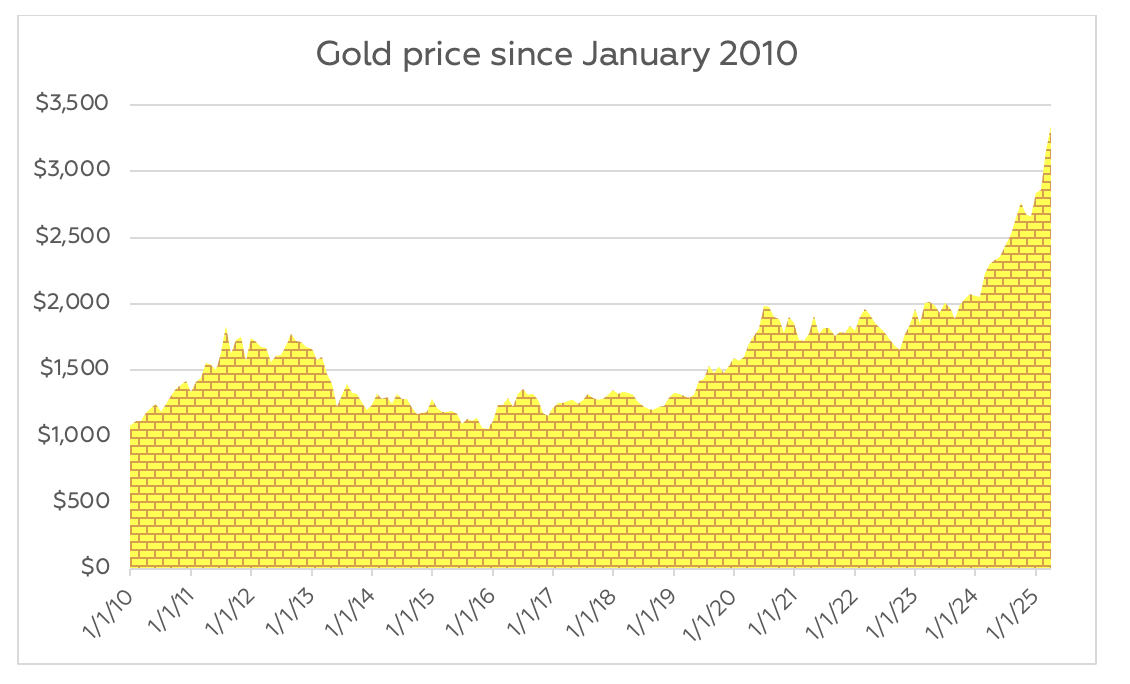
Such are the frequently sighted criticisms of buying and holding gold. To that list can be added the one bizarre aspect of the gold market, which recently came to the fore as the spectre of President Trump’s tariffs loomed. Ahead of ‘Liberation Day’, there was a mad rush to bring physical gold into the US before it attracted a possible Trump tariff. Usually, gold investment transactions do not involve the movement of gold ingots – their ownership changes but they stay in the same vault, often those of the Bank of England, in London. However, the potential tariff made gold delivered to the US more valuable than gold elsewhere, which might face a tariff on later imports.  

Sending gold from London to New York sounds simple enough – give or take the security issues and the need to beat the 2 April ‘Liberation Day’ deadline. It was not. London dominates the market in physical gold trading – buying and selling bars – whereas the New York Comex market concentrates on derivatives, such as futures. The two different markets have two different standard gold bars. The UK ingot is typically 400-troy ounces, roughly 12.5kg, whereas New York’s standard is a more pocket-friendly size of 1 kg.

Cue a gold meltdown in more ways than one – as bullion bought in London for delivery in New York was first sent to Switzerland to be melted down and recast in US-sized ingots. In a world of instant electronic trading, this sounds like madness. But this is what happened in the first three months of 2025. The new ‘gold rush’ eventually saw aircraft being used to fly the smaller bars to the US before the feared deadline. Then, on 2 April, Trump chose to exempt gold from his tariffs.

His reprieve prompted an initial fall in the price of gold to below $3,000 an ounce before it bounced back to a new record high of over $3,400 by mid-April. The rally in the price was probably also Trump-related – by that time, some investors had decided gold was a safer bolt hole than the US dollar. We are living in strange times indeed.

The value of your investment and any income from it can go down as well as up and you may not get back the full amount you invested.

Past performance is not a reliable indicator of future performance.  

Ciarán Madden
HMRC suffers from too much interest

Taxpayers relying on HMRC to sort out the tax due on interest are given a warning.

As had often been noted over the last few years, one of the strategies adopted by successive governments to increase tax revenue is the freezing of tax allowances and bands. As inflation increases income, the net result is generally to:

·       bring more people into the tax system; and

·       make existing taxpayers pay more tax, both in absolute terms and as a proportion of their income.


One frozen allowance causing growing problems is the personal savings allowance (PSA), unchanged since its introduction in 2016:


·       For basic rate taxpayers, the PSA is £1,000 per tax year, which means they have no tax to pay on their first £1,000 of interest income.

·       For higher rate taxpayers, their tax-free interest under the PSA is £500.

·       Additional rate taxpayers do not qualify for a PSA.


Until 2022, a sub-1% Bank of England Bank Rate meant that the PSA covered interest on a substantial five-figure deposit, meaning most savers had no tax to pay on their interest earnings. However, the effects of rising inflation dramatically changed the picture with higher interest rates. In the 2023/24 tax year, Bank Rate averaged about 5%. Consequently, savers earned much more interest to set against their frozen PSA.

HMRC is now struggling to collect all the income tax due on interest for 2023/24. To prevent a flood of tax returns, HMRC has previously told taxpayers that it would use the personal interest information sent directly by banks and building societies to calculate tax due on interest, and then issue a Simple Assessment or adjust their tax code. However, the volume of computations needed for 2023/24 was so great that HMRC did not complete the task of issuing assessments until March 2025. This was over a month after the normal online filing deadline for 2023/24 tax returns.

To make matters worse, HMRC was unable to match about one in five of the 130 million account reports it received to taxpayer records. HMRC is now reminding savers that the taxpayer is ultimately responsible for paying tax on interest received and that they should do so urgently if they have not heard from HMRC.

A similar problem seems certain to occur for the tax year just ended, but do not expect Rachel Reeves to increase the PSA in response. The current focus on potentially placing restrictions on cash ISAs could end up making things worse.

Tax treatment varies according to individual circumstances and is subject to change.

The Financial Conduct Authority does not regulate tax advice. 

Ciarán Madden
Are you sure you know your State Pension Age?

Research has shown the lack of awareness about the next change to the State Pension Age (SPA).

Changes to SPA have proved fertile grounds for controversy. The move to equalise women’s and men’s SPA at 65, completed in November 2018, is still a source of dispute. In March 2024, the Parliamentary and Health Service Ombudsman (PHSO) published a report recommending that the women affected by that change should each receive up to £3,000 compensation. 

A couple of days before parliament rose for its Christmas 2024 recess, the government announced that it disagreed with the PHSO and would not be following its recommendations.  Despite members of the government having sounded much more supportive of the affected women while on the opposition benches, the move was no surprise given that the suggested compensation raised a potential bill of up to £10.5 billion.

The PHSO argued that past governments had not communicated clearly enough to inform the affected women about their SPA changes. This lack of clear information occurred even though the equalisation of SPA was initially made law in 1995 (with a final target of April 2020). That date was moved earlier to November 2018 by new laws in 2011, which also brought in another SPA increase to 66 by October 2020.

Next change on the horizon

The phasing in of the next SPA increase to 67 starts in less than a year and ends in April 2028. You might have thought that the protracted debate and well-publicised legal arguments about equalisation would have meant that those affected (anyone born after 6 April 1960) knew about the change. However, recent research by the Institute for Fiscal Studies (IFS) revealed that many people remain unaware.

The IFS found that among people born between 1955 and 1965 who were interviewed between 2021 and 2023 as part of a long-term study of ageing, 40% were unclear on their position:

·       60% knew their SPA to an accuracy of within three months.

·       18% overestimated their SPA, expecting it to be higher than legislated.

·       11% underestimated their SPA.

·       11% fell into the ‘Don’t know’ category.


As the IFS noted, “Knowing one’s state pension age is crucial for financial and retirement planning.” After all, for current pensioners, on average, the State Pension makes up about 44% of overall income, according to the IFS.

Which category do you fall into? If you want to prove yourself right – or wrong – on your SPA, check at: https://www.gov.uk/state-pension-age.

Ciarán Madden
Will your next company car be a plug-in hybrid

2025 introduces a technical change to company car tax, which could alter your next choice of car.  

In recent years, the tax rules for company cars have provided a major incentive to choose a battery electric vehicle (BEV), with zero CO2 emissions, or a plug-in hybrid electric vehicle (PHEV) with CO2 emissions of 1-50g/km.

While there is no argument that a pure BEV produces no CO2, the amount of CO2 emitted by PHEVs has been called into question. A PHEV that could cover only 30–40 miles using the battery alone can have official CO2 emissions that are less than a fifth of its petrol or diesel counterpart. That surprising difference is also revealed in the official fuel consumption figures, which sometimes suggest a PHEV can cover over 200 mpg against the low 30s for the fossil fuel-only version.

That CO2 difference is now about to shrink considerably because of the replacement of the old WLTP CO2 emission test with the Euro 6e-bis standard. This new measure has been introduced by the EU as a stepping stone to a new set of emission tests, which aim to better reflect ‘real world’ emissions. Euro 6e-bis has applied to all newly launched PHEVs since 1 January 2025 and will apply to all newly manufactured PHEVs from 1 January 2026. During the current year, manufacturers will have their existing PHEVs re-tested and certified under the new regime in preparation for 2026. There are few published comparisons between the two tests for the same vehicle, but one estimate is that the CO2 emission figure could nearly double.

For company car tax purposes, Euro 6e-bis will be used in place of the old WLTP as it becomes available. However, if you have a PHEV already, then your company car tax will continue to be based on the emission figure that applied when the car was registered. If you are changing to a PHEV this year, you may find that between ordering your new car and its delivery, the emission basis changes from WLTP to Euro 6e-bis. The result could be more than a doubling in the level of company car tax. If you are relying on a salary sacrifice scheme, the outcome could be even worse if the new measure is over 75g/km.

Tax treatment varies according to individual circumstances and is subject to change.

HM Revenue and Customs practice and the law relating to taxation are complex and subject to individual circumstances and changes which cannot be foreseen.

The Financial Conduct Authority does not regulate tax advice.

Ciarán Madden